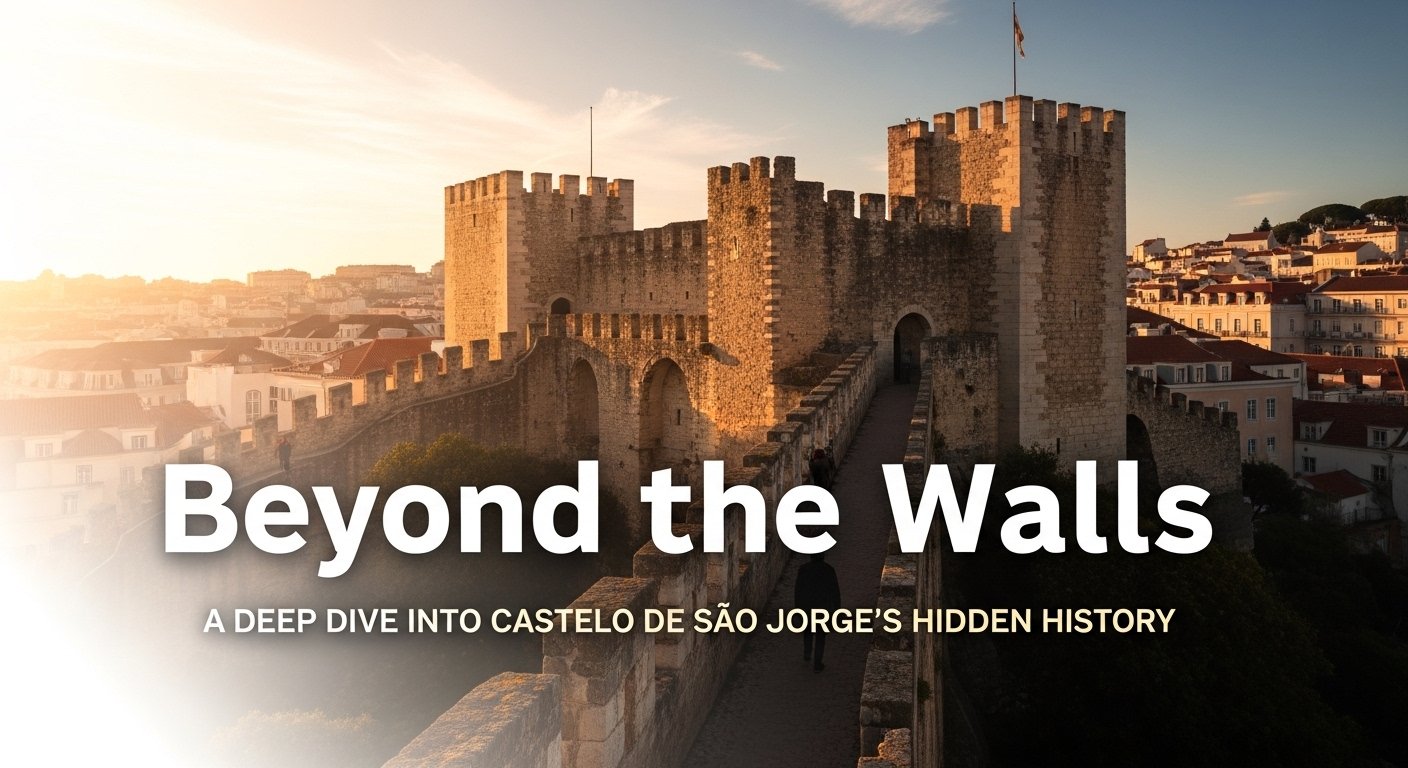
Beyond the Walls: A Deep Dive into Castelo de São Jorge’s Hidden History
There’s a moment — just before you pass through the castle’s iron gate — when the city noise drops away completely. The winding alleys of Alfama fall silent. The tram bells fade. And suddenly you’re standing inside nine centuries of layered history, most of which the average visitor walks past without a second glance.
Castelo de São Jorge is Lisbon’s most recognizable landmark, yet it remains one of its most misunderstood. Tourists climb the hill, snap a photo from the battlements, and leave.
What they miss is extraordinary: a Moorish citadel buried beneath a medieval castle, a royal palace that vanished in an earthquake, and archaeological finds that rewrote the story of human settlement in Portugal. This guide goes beyond the ticket booth.
The Real Story of Castelo de São Jorge: History That Textbooks Skip
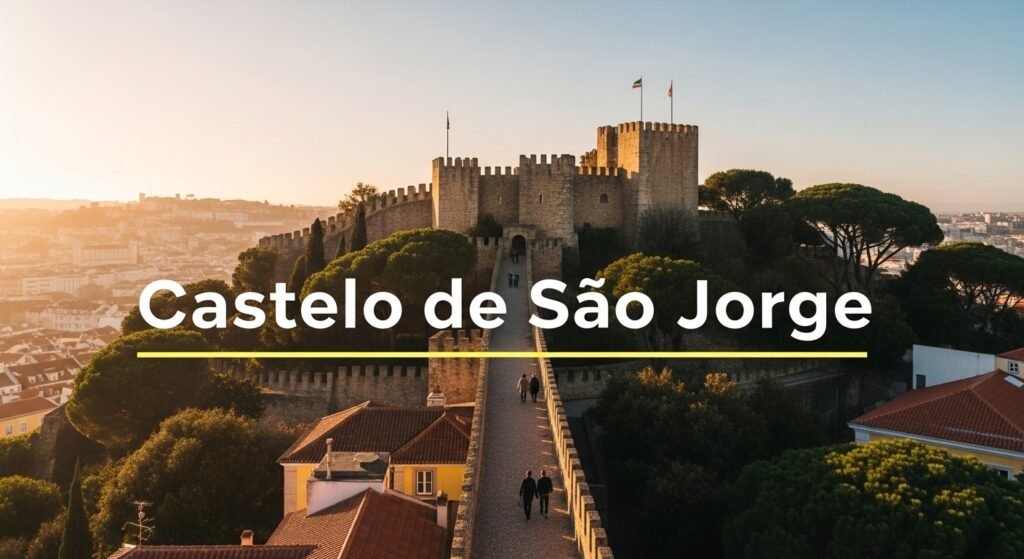
Long before it became a postcard icon or a must-visit Lisbon attraction, Castelo de São Jorge stood as a silent witness to layers of civilizations that shaped the city’s identity. Most travel guides briefly mention the Moorish period or the Christian conquest, but the true story of this hill goes much deeper—stretching back thousands of years to a time when strategic survival mattered more than architectural beauty.
Its elevated position, overlooking the Tagus River, made it an irresistible stronghold for anyone seeking control, protection, and power. This wasn’t just a castle built once—it was a continuously chosen site, reused and reshaped by different cultures who all recognized its unmatched advantage.
Before the Knights, Before the Moors: The Hill That Was Always Chosen
Long before this became a Portuguese landmark, the hill it stands on — Morro do Castelo — was among the most strategically desirable real estate in the ancient Mediterranean world. Archaeological excavations completed in the early 2000s confirmed habitation layers stretching back to the 7th century BCE, including evidence of Phoenician traders, followed by Iron Age Lusitanian peoples and then Romans, who called their settlement Olissipo.
The Romans fortified the hill properly, but it was the Visigoths in the 5th century CE who laid the first serious castle foundations. Understanding this means you’re not looking at a Moorish castle, not really — you’re looking at a site that every major civilization in Iberian history decided was worth fighting over.
Moorish Lisbon: The City the Portuguese Inherited
When the Moors arrived in 711 CE, they didn’t find an empty hilltop. They found a functioning Roman-Visigoth town and immediately recognized its value. Under Moorish rule, the castle was expanded into Al-Ushbuna’s — Lisbon’s — administrative and military nerve centre. The medina (civilian city) stretched down what is now the Alfama district, whose labyrinthine street pattern is essentially unchanged from its Moorish layout.
The Moors held the castle for over four centuries — from 711 to 1147 CE — a fact that tends to get glossed over in favor of the dramatic reconquest story. During that time, Lisbon was a prosperous Islamic city with thriving trade networks, sophisticated water systems, and a multicultural population. The castle walls you walk today incorporate Moorish stonework, most visibly in the lower eastern section near the archaeological dig site.
The 1147 Siege: What Really Happened
The official story of Afonso Henriques retaking Lisbon involves crusaders, divine providence, and a glorious siege. The full story is messier and more interesting.
Afonso was heading south to fight the Moors when a fleet of northern European crusaders — mostly Flemish, Norman, and English — stopped in Porto en route to the Holy Land. Afonso didn’t just ask for help; he negotiated. The crusaders would receive plunder rights and land grants in exchange for military assistance. What followed was a brutal four-month siege that ended not with a heroic charge, but with the Moorish governor negotiating a surrender after his water supply was cut off.
The city exchanged hands on October 25, 1147. The crusaders promptly looted it. Many never made it to Jerusalem — they stayed in the land they’d been promised. The first bishop of the newly Christian Lisbon was an Englishman: Gilbert of Hastings.
The Royal Palace Period: Lisbon’s Forgotten Versailles
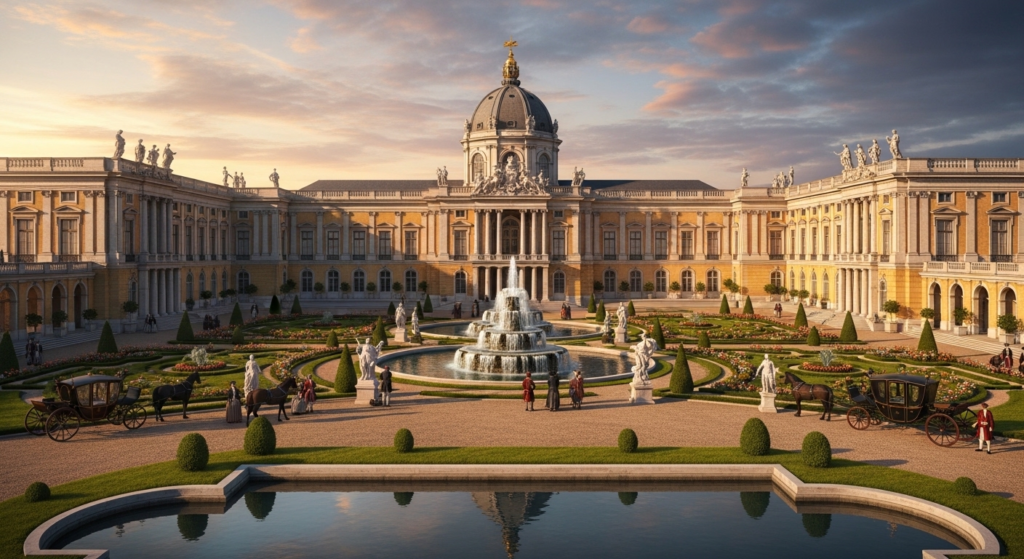
Few visitors realize that between the 13th and early 16th centuries, Castelo de São Jorge wasn’t a military installation — it was Portugal’s royal palace complex. Kings were born here, received foreign ambassadors here, and plotted the Age of Discovery from these very walls.
Dom João I celebrated his wedding here. It was from this hill that Dom Manuel I watched Vasco da Gama’s fleet depart down the Tagus in 1497, bound for India. The palace complex — which included grand halls, a royal chapel, administrative buildings, and royal gardens — was substantial enough to impress envoys from across Europe.
Then came 1755. The Great Lisbon Earthquake didn’t just destroy buildings; it erased an entire chapter of Portuguese royal history. The palace was never rebuilt. The Marquis of Pombal focused reconstruction efforts on the Baixa district below, and the castle was repurposed as a military barracks — a role it held, somewhat ignominiously, until 1938.
Things Most Tourists Miss Inside Castelo de São Jorge
The Archaeological Site (Núcleo Arqueológico)
This is the castle’s most undervisited treasure. Excavations ongoing since 1996 have uncovered 11 distinct occupation layers in the castle’s central courtyard area. You can look down through a protected viewing platform at Iron Age walls, Moorish drainage channels, and Roman mosaics — all stacked on top of each other like pages of a book.
The recovered artifacts are displayed in the small on-site museum and include Moorish ceramics, Visigoth jewelry, and Roman amphorae that once held olive oil and fish sauce from across the empire. Most visitors spend 45 minutes in the castle and walk past this entirely.
The Camera Obscura
Tucked inside one of the towers is a working Camera Obscura — a Victorian-era optical device that projects a real-time, 360-degree live image of Lisbon onto a concave white dish inside a darkened room. It’s genuinely magical: you watch tiny trams crawl through the Baixa, ferries cross the Tagus, and birds wheel over the castle walls, all in silent, moving miniature.
Only one guide operates it at a time and sessions are limited. Arrive early or ask at the ticket desk about the next available viewing. This is one of the most unusual experiences in all of Lisbon and almost nobody knows it exists.
The Haunted Tower: Torre de Ulisses
According to medieval legend, Castelo de São Jorge was founded by Ulysses himself — yes, Homer’s Ulysses — and Lisbon takes its name from Olissipo, supposedly derived from his name. The Torre de Ulisses, one of the castle’s original towers, is where the Camera Obscura is now housed, but its name preserves this ancient myth.
Wander to the far eastern battlements, away from the main viewpoint crowds, and you’ll find a stretch of original Moorish rubble masonry (identifiable by the smaller, irregular stones set in horizontal courses) that most visitors never reach.
The Swan and Peacock Gardens
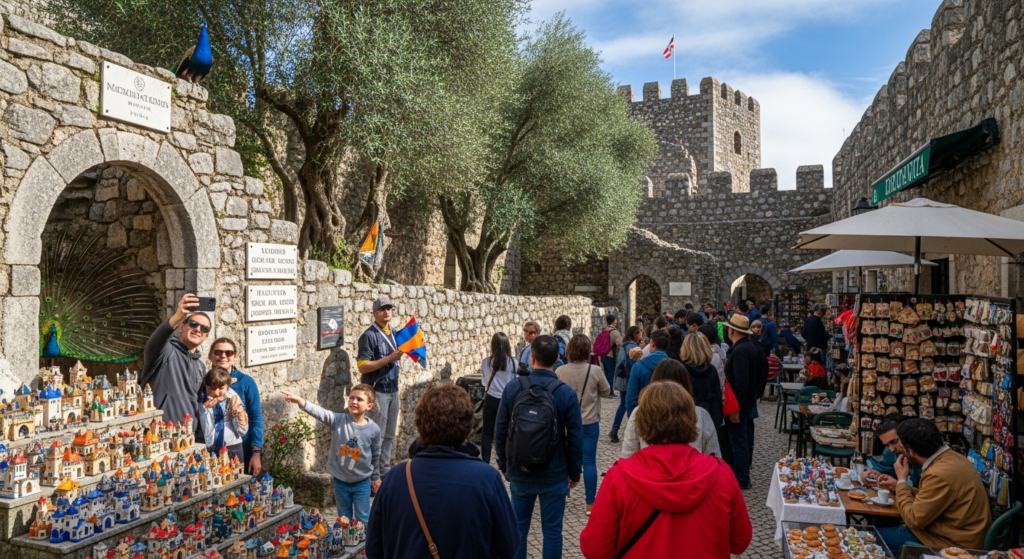
The central courtyard contains free-roaming white swans, peacocks, and ducks — a tradition dating to the medieval royal court period. The peacocks are completely unbothered by human presence and will occasionally fan their tails without warning in the middle of the path. It’s surreal and delightful and entirely unremarkable to the locals.
A Practical Visitor’s Guide to Castelo de São Jorge
Getting There Without the Tourist Shuffle
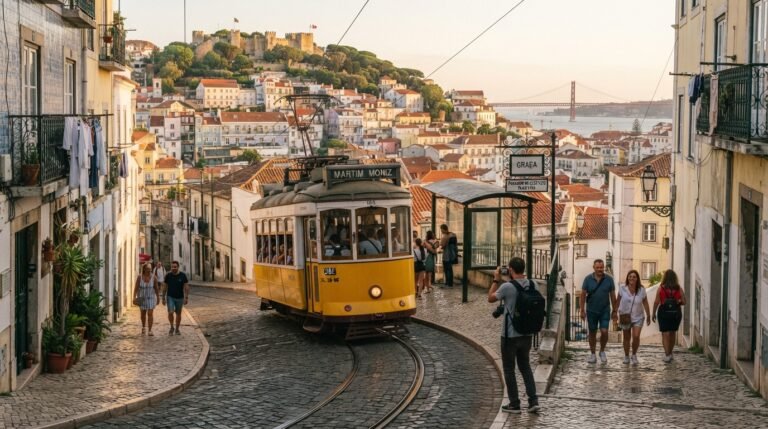
Skip Tram 28. It’s chronically overcrowded and infamous for pickpockets. Instead:
- Walk up from Rossio via Rua da Madalena and Rua Augusta — about 20 minutes, mostly uphill through quieter backstreets.
- Take Bus 737 from Praça da Figueira — it stops near the castle entrance and takes 10 minutes.
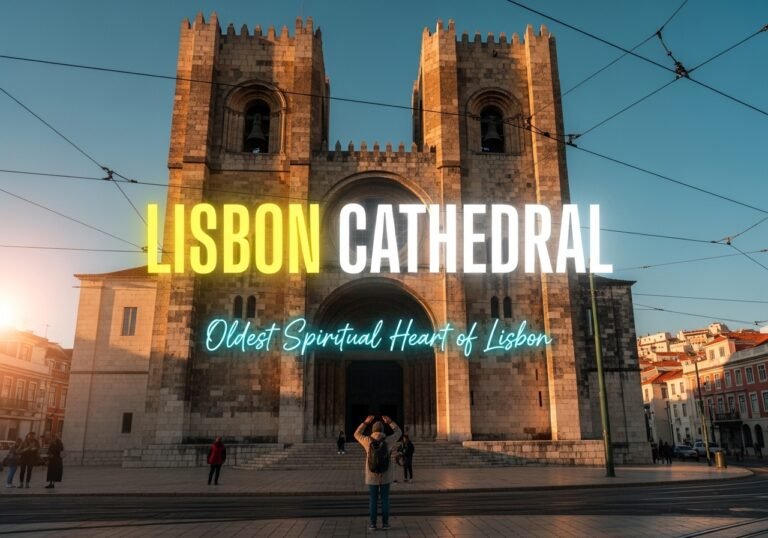
- Walk from the Sé Cathedral — it’s a 10-minute uphill walk through Alfama’s best alleys and far more atmospheric.
Tickets, Timing, and What to Book in Advance
| Detail | Info |
|---|---|
| Adult ticket | €15 |
| Youth (13–25) | €7.50 |
| Under 12 / over 65 | Free |
| Opening hours | Nov–Feb: 9am–6pm / Mar–Oct: 9am–9pm |
| Best time to visit | Weekday mornings, before 10am |
| Camera Obscura | Included with entry, but limited capacity |
Book online via the official Castelo de São Jorge website to skip the queue — especially in summer, when the line can stretch 45 minutes. The last entry is 30 minutes before closing.
How Long to Spend
Most visitors allocate an hour. Allocate two. Between the archaeological site, the Camera Obscura, the full circuit of the battlements, and a proper sit-down at the viewpoint facing the Tagus, you need at minimum 90 minutes to do the castle justice.
Pro Tips From Someone Who’s Been Here a Dozen Times
1. Come at dusk, not midday. The golden hour light over the Tagus from the eastern battlements is extraordinary. If you visit in summer, an evening ticket (the castle stays open until 9pm) means dramatically better light, smaller crowds, and cooler temperatures.
2. Bring water and a snack. The castle café is overpriced and the queues are brutal. There are no vending machines once you’re inside.
3. The best Alfama views aren’t from the main viewpoint. Walk the full battlements circuit to the northeast tower for a completely unobstructed view over the red-roofed Alfama all the way to the Tagus. You’ll often have it to yourself.
4. Download the audio guide app (available free on the castle’s website) before you go — the on-site information panels are sparse, and the app provides substantial historical context at key points.
5. Combine with the Sé Cathedral visit. The Sé is a 10-minute walk downhill and is dramatically undervisited. Its Romanesque nave dates to 1147 — the same year as the castle’s conquest — and the cloister contains its own archaeological excavations.
How Castelo de São Jorge Compares to Other Lisbon Landmarks
Lisbon rewards the historically curious, but not all of its landmarks deliver equally on depth.
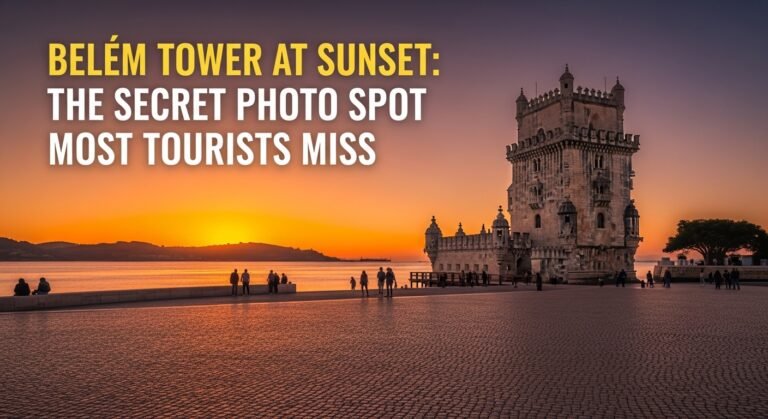
Versus Belém Tower: The Torre de Belém is visually iconic but small — most visitors spend 30–40 minutes there. Castelo de São Jorge offers vastly more historical layering and space to explore. If you have to choose one, the castle wins on substance.
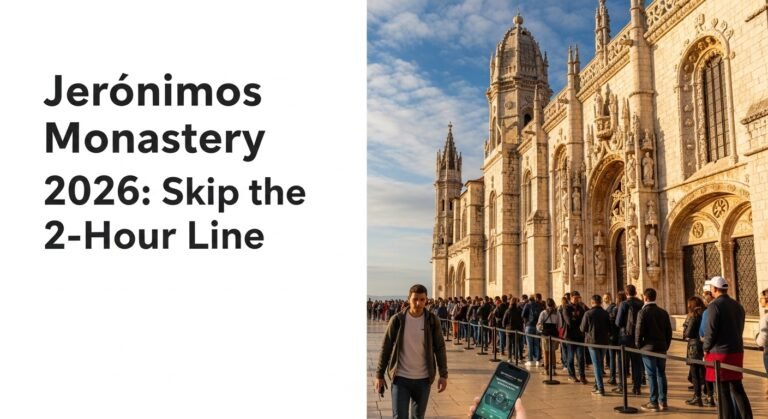
Versus Jerónimos Monastery: The monastery is architecturallyThe Castle’s Real Secret
Here’s what strikes you, if you spend enough time inside: Castelo de São Jorge isn’t preserved despite Lisbon’s history — it is Lisbon’s history, compressed into one hill. Every stone represents a different civilization’s decision that this was worth holding, worth defending, worth building on.
The tourists who spend 45 minutes here and move on aren’t wrong to visit. They’re just leaving before the place has had a chance to speak.
Come back at dusk. Walk the full circuit. Find the Moorish stones in the eastern wall. Stand in the darkened Camera Obscura room and watch your city move in miniature. Then you’ll understand what makes this hill different from every other viewpoint in Lisbon. unmatched — its Manueline cloister is among the finest in Europe. But it’s a sacred space with restricted access to most areas. The castle invites exploration and rewards wandering in ways a monastery can’t.
Versus the Museu Nacional de Arqueologia: For those captivated by the castle’s archaeological site, the National Archaeology Museum in Belém provides essential context — it houses many artifacts from sites like São Jorge and tells the broader story of pre-Roman Portugal.
The castle occupies a unique position: it’s the only major Lisbon landmark where you can stand inside the city’s oldest continuously inhabited site, walk medieval battlements, and look down on the entire city from the same vantage point that every conqueror in Lisbon’s history chose first.
The Castle’s Real Secret
Here’s what strikes you, if you spend enough time inside: Castelo de São Jorge isn’t preserved despite Lisbon’s history — it is Lisbon’s history, compressed into one hill. Every stone represents a different civilization’s decision that this was worth holding, worth defending, worth building on.
The tourists who spend 45 minutes here and move on aren’t wrong to visit. They’re just leaving before the place has had a chance to speak.
Come back at dusk. Walk the full circuit. Find the Moorish stones in the eastern wall. Stand in the darkened Camera Obscura room and watch your city move in miniature. Then you’ll understand what makes this hill different from every other viewpoint in Lisbon.
FAQs
What is the history of Castelo de São Jorge in Lisbon?
Castelo de São Jorge sits on a hill inhabited since at least the 7th century BCE. It served as a Moorish citadel from 711 CE, was captured by the first Portuguese king in 1147, and functioned as the royal palace until the 1755 earthquake destroyed the palace complex. Today it incorporates archaeological remains from Phoenician, Roman, Visigoth, Moorish, and medieval Portuguese periods.
Is Castelo de São Jorge worth visiting?
Yes — particularly if you go beyond the main viewpoint. The archaeological site, Camera Obscura, and full battlements circuit make it one of Lisbon’s most rewarding landmarks for anyone interested in history or panoramic views of Alfama and the Tagus.
What are the best views from the castle?
The northeast battlements offer the best unobstructed views over Alfama’s rooftops toward the Tagus. The main western viewpoint is more crowded but frames the Baixa and Ponte 25 de Abril bridge beautifully at sunset.
What’s the best time of day to visit?
Early morning (before 10am) for smaller crowds, or late afternoon/dusk for the best light and photography. Summer evening visits (the castle is open until 9pm) are particularly atmospheric.
Can you see the Camera Obscura without a separate ticket?
Yes — it’s included with general entry. However, sessions are limited and guided. Ask at the ticket desk for the next available time immediately upon entering.
How do I get to Castelo de São Jorge from central Lisbon?
Bus 737 from Praça da Figueira is the most convenient. Walking from the Sé Cathedral through Alfama takes about 10 minutes and is the most atmospheric approach. Avoid the overcrowded Tram 28.