
Lisbon Neighborhood Guide: Where to Stay Based on Your Travel Style
Selecting the correct base in Lisbon is the most critical logistical decision a visitor will make. Known as the “City of the Seven Hills,” Lisbon’s topography dictates that two neighborhoods appearing adjacent on a map may actually be separated by a grueling vertical ascent. To maximize efficiency and comfort, accommodation choices should align with specific mobility needs, noise tolerances, and proximity to primary transit arteries.
The Strategic Overview: Matching Style to District
For those seeking an immediate answer to the optimal location, the following table categorizes Lisbon’s primary districts by their functional utility:
| Travel Style | Recommended Neighborhood | Key Advantage |
| First-Time Visitors | Baixa & Chiado | Centrality, flat terrain, and major transit hubs. |
| History & Romance | Alfama | Authentic Fado culture and medieval architecture. |
| Nightlife & Social | Bairro Alto / Cais do Sodré | Highest concentration of bars and late-night dining. |
| Luxury & Quiet | Avenida da Liberdade | High-end boutiques, wide boulevards, and 5-star service. |
| Trendy & Local | Príncipe Real | Independent design shops and upscale botanical gardens. |
| Families & Space | Belém | Riverside parks, flatter streets, and cultural monuments. |
Topography and Transit Logistics
One must understand that Lisbon’s beauty is inextricably linked to its steep gradients. The city operates on a complex but efficient network of metros, yellow trams (elétricos), funiculars (ascensores), and buses managed by Carris.
For most travelers, staying near the Blue or Green Metro lines is the most effective way to navigate. However, in historic districts like Alfama or Bairro Alto, the metro does not penetrate the narrowest streets, necessitating the use of the iconic Tram 28 or ride-sharing apps like Bolt or Uber. It is highly recommended to procure a Viva Viagem card or a Lisboa Card immediately upon arrival at Portela Airport (LIS) to utilize the “Zapping” system, which reduces the cost of individual journeys across all transport modes.
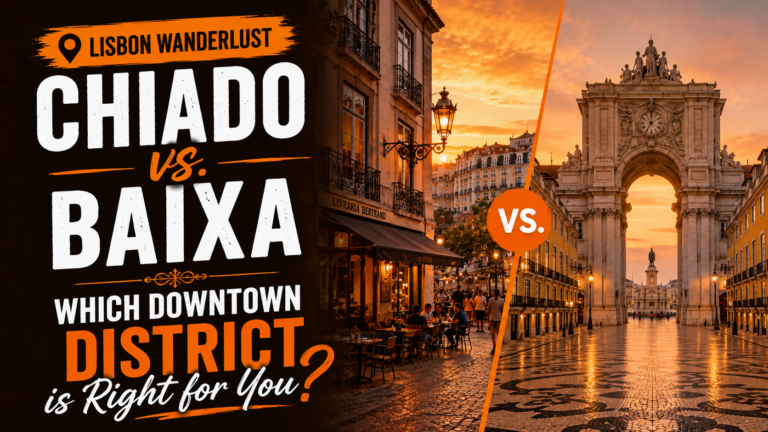
Baixa & Chiado – The Central Hub
Baixa is the symbolic heart of Lisbon, rebuilt by the Marquês de Pombal after the 1755 earthquake. It is characterized by a strict grid of wide, neoclassical streets and grand plazas. Directly uphill to the west lies Chiado, the city’s sophisticated literary and shopping district.
Logistical Advantages:
- Accessibility: Baixa is the flattest area in the historic center, making it the premier choice for those with limited mobility or heavy luggage.
- Connectivity: The Rossio train station provides direct access to Sintra, while the Baixa-Chiado metro station acts as the primary interchange between the Blue and Green lines.
- Proximity: Landmarks such as the Praça do Comércio, Rua Augusta Arch, and the Santa Justa Lift are all within a 5-to-10-minute walk.
Strategic Insights for Accommodation: When booking in Baixa, it is advisable to distinguish between the pedestrianized Rua Augusta—which can be noisy due to high foot traffic and street performers—and the parallel streets like Rua dos Douradores or Rua da Madalena, which offer a quieter environment while remaining central. In Chiado, the area surrounding Praça Luís de Camões is the epicenter of activity; staying here places one at the doorstep of the city’s best cafes, such as A Brasileira, but expect significant ambient noise until late evening.
Know-Before-You-Go: The convenience of Baixa comes with a “tourist premium.” Dining in this district is often more expensive and less authentic than in residential neighborhoods. Travelers are encouraged to walk 10–15 minutes north toward Martim Moniz or south toward the riverfront for higher-quality gastronomic options.
Alfama & Graça – The Historic Soul
Alfama represents the oldest vestige of Lisbon, having largely survived the 1755 earthquake. Its layout is a labyrinthine network of narrow alleys, steep staircases (escadinhas), and small squares. Rising above Alfama is Graça, a neighborhood offering some of the city’s highest viewpoints (miradouros).
Logistical Profile:
- Topography: This is the most challenging area for mobility. The gradients are extreme, and the streets are paved with traditional calçada portuguesa, which becomes slippery when wet.
- Transit Access: Metro access is limited to the perimeter (Santa Apolónia station). The primary internal transport is the Tram 28, which is frequently over-capacity. Visitors should consider the 12E Tram or the 737 Bus as less crowded alternatives.
- Luggage Warning: Many buildings in Alfama are centuries old and lack elevators. It is standard for apartments to require navigating three or four flights of narrow, steep stairs.
The Resident Experience: Staying in Alfama provides immediate access to the city’s Fado culture. However, travelers must account for the auditory environment. Sound echoes significantly in narrow stone streets; the mournful notes of Fado performances often continue until midnight, followed by the logistical sounds of morning waste collection. For a quieter experience within this district, one should seek accommodation near the National Pantheon or the upper reaches of Graça.
Strategic Information Gain: During June, Lisbon celebrates the Santos Populares (Feast of St. Anthony). Alfama becomes the epicenter of street parties, with makeshift grills and music systems installed in every alleyway. While culturally significant, the noise and crowds make sleep nearly impossible for residents during this peak period. Outside of June, Alfama is best suited for those traveling with light luggage and a preference for historical immersion over modern convenience.
Alfama Compatibility Check
Before booking a charming historic apartment, ensure you can navigate the following local conditions:
Pro Tip: If you have heavy luggage, book a taxi to the “Largo das Portas do Sol” and walk downhill to your stay.
Bairro Alto & Cais do Sodré – The Epicenter of Energy
To the west of the central valley lies Bairro Alto, a 16th-century district that undergoes a daily metamorphosis. By day, it is a quiet, shuttered residential area; by night, it transforms into the city’s primary nightlife destination. Directly downhill toward the Tagus River sits Cais do Sodré, a former maritime transit point that has evolved into one of Europe’s trendiest culinary and social hubs.
Logistical Profile:
- Topography: Bairro Alto is situated on a high plateau. Access from Baixa is best achieved via the Elevador da Glória funicular or the escalators within the Baixa-Chiado Metro station. Cais do Sodré is entirely flat and riverside.
- Transit Access: Cais do Sodré is a major intermodal terminal. It connects the Green Metro Line, the suburban train to Cascais/Estoril, and the ferries to Cacilhas (for the Christ the King statue).
- Noise Warning: These districts are the loudest in Lisbon. Bairro Alto’s streets are narrow, and sound travels upward. Cais do Sodré, specifically the “Pink Street” (Rua Nova do Carvalho), remains active until 4:00 AM or later on weekends.
Strategic Insights for Accommodation: For travelers who prioritize social life but require sleep, the “Buffer Zone” strategy is essential. Seek accommodation on the western fringes of Bairro Alto, near Praça das Flores or Santa Catarina. These areas provide the same aesthetic charm but are shielded from the primary bar crawl routes. In Cais do Sodré, hotels on the upper floors of the Av. 24 de Julho offer soundproofed windows and proximity to the Time Out Market (Mercado da Ribeira).
Information Gain: The Commuter Advantage: Cais do Sodré is the superior choice for travelers planning day trips to the Atlantic beaches. The train to Cascais departs every 20 minutes, reaching the coast in approximately 30 to 40 minutes. Staying here eliminates the need for a secondary transfer from the city center, saving approximately 45 minutes of daily transit time.
The Sleep vs. Social Checklist
Bairro Alto and Cais do Sodré are high-energy zones. Before booking, ensure your property offers these three essential “Quiet Stay” features:
- ✅ Double-paned soundproof windows (Essential)
- ✅ Location at least 2 streets away from “Pink Street”
- ✅ Air conditioning (so windows can remain closed at night)
Avenida da Liberdade – The Luxury Corridor
Avenida da Liberdade is Lisbon’s premier boulevard, designed in the late 19th century to emulate the grand avenues of Paris. Stretching from Praça dos Restauradores to Marquês de Pombal, this tree-lined thoroughfare is the city’s commercial and luxury heartbeat, home to flagship designer stores and 5-star hotel chains.
Logistical Profile:
- Topography: This is one of the few areas in the city with a gentle, consistent slope and wide, paved sidewalks. It is highly accessible for those using strollers or wheelchairs.
- Transit Access: The Blue Metro Line runs directly beneath the avenue, with three stops along its length (Restauradores, Avenida, and Marquês de Pombal). This provides a 5-minute connection to the Baixa district and a direct 20-minute link to the airport via the Red/Blue line interchange.
- Environment: Extremely quiet at night compared to the historic center, as the area is dominated by offices and high-end residential buildings rather than bars.
Strategic Insights for Accommodation: Avenida da Liberdade is the ideal base for the business traveler or the luxury-oriented vacationer. Unlike the cramped quarters of Alfama or Bairro Alto, the hotels here typically offer modern amenities such as elevators, spacious lobbies, gyms, and rooftop pools. For the most tranquil experience, travelers should request rooms facing the internal courtyards rather than the main boulevard, although traffic noise is generally well-managed by modern construction standards.
Know-Before-You-Go: The Dining Landscape: While the Avenue offers world-class dining, it is significantly more expensive than other districts. For a more “local” price point, one only needs to walk one block east into the Santana neighborhood or west towards Rato. These parallel districts offer traditional Portuguese tascas at roughly 60% of the price found on the main boulevard.
Luxury & Accessibility Audit
Avenida da Liberdade is the best choice for travelers with specific mobility requirements.
| Feature | Rating |
|---|---|
| Sidewalk Width | Excellent (Wide/Paved) |
| Metro Access | High (3 Dedicated Stops) |
| Stroller Friendly | Yes (Top Tier) |
Príncipe Real – The Sophisticated Choice
Positioned uphill from Avenida da Liberdade, Príncipe Real is Lisbon’s most fashionable and “gentrified” neighborhood. It is characterized by colorful 19th-century mansions, hidden botanical gardens, and a distinct LGBTQ+ friendly atmosphere.
Logistical Profile:
- Topography: Situated on a ridge, the neighborhood is relatively flat once you reach the top, but getting there from the waterfront involves a steep climb unless using the Elevador da Glória or a taxi.
- Transit Access: There is no metro station in the heart of Príncipe Real. The nearest stops are Rato (Yellow Line) or Avenida (Blue Line), both of which require a 10-minute uphill walk. Most residents rely on the 758 Bus or ride-sharing apps.
- Retail & Green Space: Home to the Jardim do Príncipe Real and the Reservatório da Patriarcal. It offers the highest density of concept stores and independent boutiques in the city.
The “Local Expert” Information Gain: Staying in Príncipe Real provides a “neighborhood feel” that Baixa lacks. On Saturday mornings, the park hosts an organic farmers’ market (Mercado Biológico) and an antique fair. It is the best location for those who appreciate design and slow travel. However, because of the lack of direct metro access, it is less suited for travelers who plan to return to their hotel multiple times a day. It is a “depart in the morning, return in the evening” type of neighborhood.
Príncipe Real Lifestyle Index
Is this district right for your travel style? See how it ranks:
Boutiques
Dining
Metro Link
Safety
Verdict: Best for Design Lovers & Slow Travelers
Belém – The Monumental Riverside Outlier
Situated approximately 6 kilometers west of Baixa, Belém offers a distinct atmosphere characterized by open spaces, maritime monuments, and riverside gardens. It was from these shores that the Portuguese explorers set sail during the Age of Discovery.
Logistical Profile:
- Topography: This is Lisbon’s flattest major district. The lack of hills makes it highly favorable for families with young children and those who prefer cycling or walking long distances by the water.
- Transit Access: Belém is not served by the Metro. Visitors must use the 15E Tram (modern articulated trams) or the Cascais Line suburban train (get off at Belém station). The journey from the city center takes approximately 15–20 minutes.
- Connectivity: The train connects Belém directly to the beaches of Carcavelos and Cascais, making it an excellent midpoint between urban culture and coastal relaxation.
Strategic Insights for Accommodation: Staying in Belém means trading central “buzz” for tranquility and space. Hotels here are often larger and more modern, such as those near the Belém Cultural Center (CCB). It is an ideal base for travelers who have already seen Lisbon’s center or those who prioritize visiting the Jerónimos Monastery and the Belém Tower before the mid-day tourist crowds arrive.
Know-Before-You-Go: The Commuter Reality: The 15E tram can become exceptionally crowded during peak tourist hours (10:00 AM – 4:00 PM). To avoid delays, it is more efficient to use the train from Cais do Sodré or take a taxi/Bolt, which costs roughly €6–€9 from the city center. Be aware that most restaurants in Belém close earlier than those in Bairro Alto or Chiado, so plan for dinner around 8:00 PM.
Belém Transit Strategy
Since Belém is not on the Metro line, use this shortcut to save 20 minutes on your commute:
The “Train Secret”: Skip the crowded 15E Tram. Take the suburban train from Cais do Sodré (Line: Cascais). It’s faster, has more capacity, and uses the same Viva Viagem card.
Parque das Nações – Modernity and Convenience
The Parque das Nações was the site of the 1998 World Expo and represents the ultra-modern face of Lisbon. Located in the northeast of the city near the airport, it features futuristic architecture, a massive aquarium, and a sprawling riverside park.
Logistical Profile:
- Topography: Completely flat with wide, paved promenades.
- Transit Access: Home to Estação do Oriente, a massive transit hub designed by Santiago Calatrava. It houses the Red Metro Line (direct to the airport in 5 minutes), high-speed trains to Porto and the Algarve, and a central bus terminal.
- Ideal For: Travelers with early flights, business attendees at the FIL (Lisbon Exhibition and Congress Centre), or families seeking the Oceanário de Lisboa.
Information Gain: The Strategic Advantage: If the primary goal of the trip includes regional travel (such as a day trip to Coimbra or a multi-day excursion to Porto), Parque das Nações is the most logical logistical base. While it lacks the historical “soul” of the old city, it offers the most seamless transit experience in Portugal.
Airport Proximity Alert
Stay in Parque das Nações if your itinerary includes:
Transit Note: The Red Metro line connects Oriente Station to Lisbon Airport in just 3 stops (approx. 5-7 minutes).
Final Summary and Comparison Guide
To conclude the logistical assessment, the following table provides a final comparative overview to assist in the final selection process.
| Neighborhood | Vibe | Noise Level | Walkability | Transit Score |
| Baixa | Heart of action | Moderate | High (Flat) | 10/10 |
| Alfama | Historic/Fado | Moderate/High | Low (Hills) | 4/10 |
| Bairro Alto | Party Central | Very High | Moderate | 6/10 |
| Av. Liberdade | High-End | Low | High | 9/10 |
| Príncipe Real | Trendy/Chic | Low | Moderate | 5/10 |
| Belém | Historic/Quiet | Very Low | High | 7/10 |
| P. das Nações | Modern/Easy | Very Low | High | 10/10 |
Conclusion: Synthesizing the Lisbon Stay
Selecting the ideal neighborhood in Lisbon requires a deliberate trade-off between historical atmosphere and logistical convenience. For the traveler prioritizing ease of movement and proximity to major sights, Baixa and Chiado remain the gold standard. Conversely, those seeking the evocative, traditional soul of the city will find it in Alfama, provided they are prepared for the physical demands of its topography.
For a modern, high-end experience with seamless airport and regional rail connectivity, Avenida da Liberdade and Parque das Nações offer a stark but functional contrast to the winding alleys of the historic center. Ultimately, Lisbon’s efficient transit network—anchored by the Metro and the suburban train lines—ensures that regardless of the chosen base, the city’s diverse districts remain accessible within a 20-minute journey.