
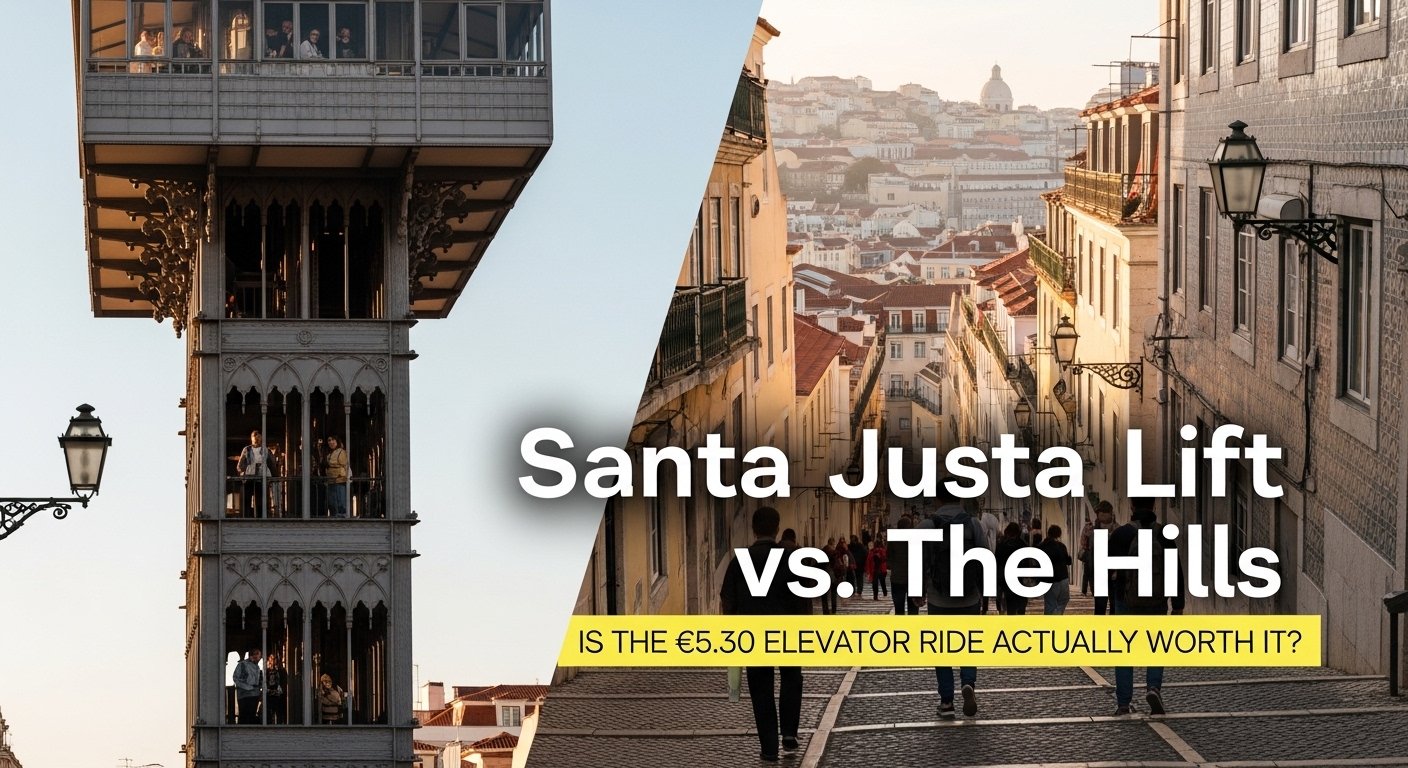
Santa Justa Lift vs. The Hills: Is the €5.30 Elevator Ride Actually Worth It?
Welcome to Lisbon Wanderlust. If you’ve spent more than five minutes scrolling through Instagram while planning your Portugal getaway, you’ve undoubtedly seen it: a soaring, neo-Gothic iron tower rising above the terracotta rooftops of the city. It is the Santa Justa Lift Lisbon, a landmark so iconic it practically defines the skyline of the Baixa district.
But here is the catch that many travelers don’t realize until they are standing on the pavement in the sweltering heat: it costs €5.30 for a ride that lasts less than a minute. As you look at the winding Elevador de Santa Justa queue stretching down the block, you might find yourself glancing at the steep cobblestone streets nearby and wondering—is it actually faster, cheaper, and better to just walk?
In this guide, we’re breaking down the cost-value reality of this historic monument. We’ll compare the ride to the classic Baixa to Chiado walking routes and share the “smart traveler” hacks that could save you both time and money. By the end, you’ll know exactly whether to join the line or save your Euros for an extra pastel de nata.
Quick Comparison Table: Santa Justa Lift vs. Walking
| Factor | Santa Justa Lift | Walking the Hills |
|---|---|---|
| Cost | €5.30 (or free with Lisbon Card) | Free |
| Time | 30–60 mins (with queue) | 10–15 minutes |
| Experience | Vintage, industrial, brief | Immersive, active, scenic |
| Views | Good (from the top) | Better (multiple angles) |
| Effort | Zero | Moderate (steep climb) |
What Is the Santa Justa Lift? A Quick Overview for First-Time Visitors
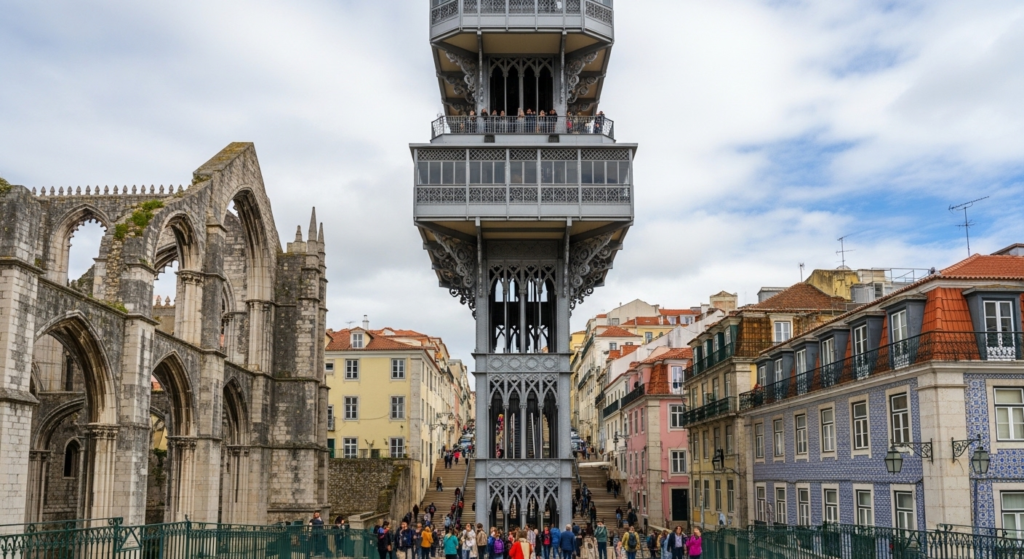
The Elevador de Santa Justa is much more than just a vertical shortcut; it is a masterpiece of early 20th-century industrial architecture. Inaugurated in 1902, it was designed by Raúl Mesnier de Ponsard, an apprentice of Gustave Eiffel (hence the striking resemblance to the Eiffel Tower). While Lisbon is famous for its yellow trams and funiculars, this is the city’s only remaining vertical street lift.
Originally powered by steam and later electrified in 1907, the lift was built to solve a practical problem: how to move citizens from the harbor-level commercial district of Baixa to the upscale, hilltop neighborhood of Chiado without breaking a sweat. Today, while it still functions as part of the public transport network, it has transformed into one of the most popular Lisbon viewpoints (miradouros).
Standing 45 meters tall, the structure is made of cast iron and decorated with intricate filigree. Its two wood-paneled cabins are a throwback to the Belle Époque era, offering a vintage atmosphere that few other modern attractions can replicate. For many, it is the ultimate symbol of Lisbon’s “Age of Iron” and a must-see piece of Portuguese heritage.
Where It Connects: Baixa to Chiado Explained
The lift serves as a direct bridge between two distinct worlds. At the bottom, you are in Baixa, the flat, grid-like heart of the city rebuilt after the 1755 earthquake. At the top, you exit onto a walkway that leads directly to Largo do Carmo, a beautiful square in the Chiado district known for the haunting ruins of the Carmo Convent.
Ticket Price, Opening Hours, and Entry Points
As of 2026, the standard Lisbon elevator price for a return trip purchased at the ticket office is €5.30. The lift operates daily, generally from 7:00 AM to 10:45 PM (with slight seasonal variations). You can board at the bottom on Rua de Santa Justa or enter via the upper walkway behind the Carmo Convent to ride it downward.
Why It Became One of Lisbon’s Most Famous Attractions
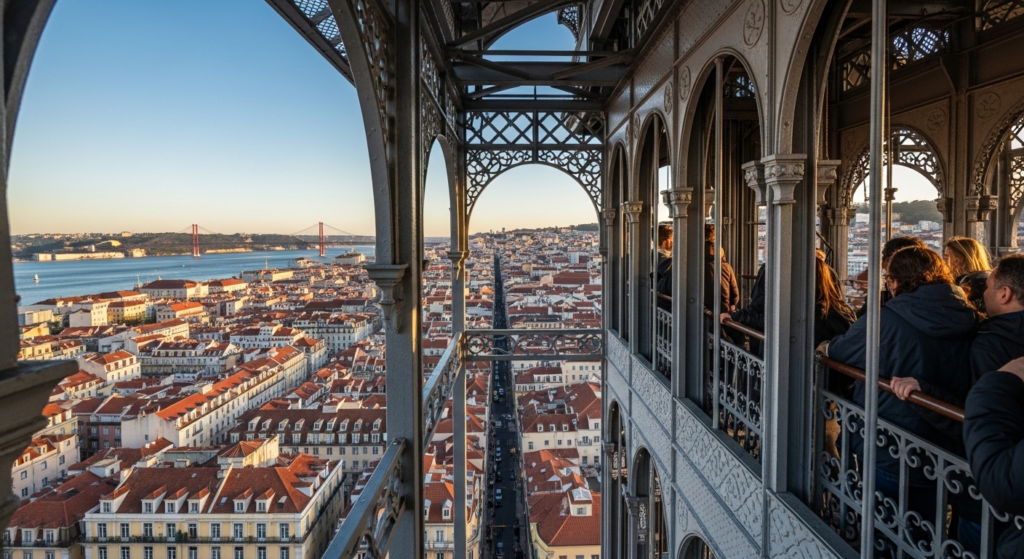
Beyond its utility, the lift offers a unique perspective. Because it sits in the middle of the valley, the views from the top provide a 360-degree look at the Castle of St. George, the Rossio Square, and the Tagus River. It’s this combination of historic charm and panoramic payoff that keeps it at the top of every “things to do in Lisbon” list.
The Real Experience: Riding the Santa Justa Lift
Stepping into the Santa Justa Lift Lisbon is like entering a time capsule. The interior is clad in polished wood and brass, and a uniformed operator still manually controls the doors. However, the “real” experience often begins long before the doors open. Because the cabins only hold about 20-25 people, the movement of the crowd is notoriously slow, making the wait a significant part of your itinerary.
Once inside, the ascent is remarkably smooth and surprisingly brief. You’ll feel a slight hum as the cast-iron gears pull you upward, and through the windows, the rooftops of Baixa begin to drop away. It’s a momentary escape from the bustling city streets below, though the ride itself is over in roughly 45 seconds.
The experience doesn’t end when the cabin stops. You exit onto a scenic walkway that offers your first real breath of fresh air and a view of the Carmo ruins. For many, the highlight is the transition—the feeling of being suspended between the historic ruins of the hilltop and the vibrant commercial life of the valley.
The Queue Situation: How Long You’ll Actually Wait
In peak season (May to September), the Elevador de Santa Justa queue can easily exceed an hour. Even in the off-season, mid-day waits of 30 to 45 minutes are common. If you are on a tight schedule, this “shortcut” can ironically become the longest part of your afternoon.
What the Ride Feels Like (Duration, Views, Space)
The ride is short—very short. While the vintage aesthetics are charming, you are often packed in tightly with other tourists. If you are looking for a leisurely sightseeing experience, the cabin ride itself might feel underwhelming compared to the grandeur of the exterior structure.
The Observation Deck: Is It Worth the Extra Climb?
At the very top, there is a spiral staircase leading to a narrow observation deck. Access to this platform is often an additional €1.50 (unless included in certain transport passes). It provides the highest vantage point in the immediate area, but the space is cramped, and the view from the free walkway below is nearly as good.
Walking Lisbon’s Hills: The Free Alternative
If the thought of standing in line for an hour makes you shudder, Lisbon hills walking is your best friend. Walking from Baixa to Chiado is not just a free alternative; it’s an opportunity to see the city at your own pace. While Lisbon is famous for its “Seven Hills,” the climb from the bottom of the lift to the Largo do Carmo is actually one of the more manageable ascents.
Walking allows you to appreciate the details that the lift skips over. You’ll pass by tiny boutiques, traditional tile-fronted houses, and local cafes where the smell of coffee and pastries fills the air. It’s an immersive experience that turns a “transport task” into a scenic stroll. For many, the “struggle” of the hills is exactly where the charm of Lisbon lies.
Furthermore, the walk only takes about 10 to 15 minutes if you go directly. When you compare 12 minutes of walking to 60 minutes of standing in a queue, the “legs” option usually wins for the time-conscious traveler. You’ll arrive at the same destination—the Carmo Convent—feeling like you’ve actually explored the neighborhood.
Baixa to Chiado Walk: What to Expect Step-by-Step
The most common route starts at Rossio Square. You’ll head up Rua do Carmo, a pedestrian-friendly street lined with shops like H&M and local jewelers. About halfway up, you’ll turn right onto the steep but beautiful Rua Garrett, which leads you straight into the heart of Chiado’s literary and cafe culture.
Elevation, Effort, and Fitness Level Required
The climb is steep but short. If you have average mobility, it is perfectly doable. The streets are paved with the famous calçada portuguesa (white and black stones), which can be slippery when wet, so good walking shoes are a must. It’s a “breathless” walk, but certainly not a mountain hike.
Hidden Gems You Miss by Taking the Lift
By walking, you’ll pass the Livraria Bertrand (the world’s oldest bookstore) and the famous A Brasileira cafe, where a statue of poet Fernando Pessoa sits. These are essential Lisbon landmarks that you would completely bypass if you took the vertical “tunnel” of the elevator.
Cost vs. Value: Is €5.30 Justified?
When assessing is Santa Justa Lift worth it, the answer largely depends on your travel style and budget. At over five Euros, it is one of the most expensive “per minute” attractions in the city. For a family of four, that’s over €20 for a one-minute ride—enough to buy a full lunch in many local tascas.
For budget-conscious travelers, the price is hard to justify when walking is free and arguably more scenic. However, the value isn’t just in the transport; it’s in the novelty. You are paying for the “ride” on a National Monument. If you view it as a museum entry rather than a bus ticket, the price feels more reasonable.
Interestingly, many tourists don’t realize they are overpaying. The €5.30 is the “on-board” tourist price. If you use a Viva Viagem card (the local transit card) or a 24-hour pass, the ride is significantly cheaper or even included. This shifts the value proposition entirely from “tourist trap” to “transport perk.”
Comparing to Other Lisbon Attractions
A ticket to the São Jorge Castle is roughly €15, providing hours of exploration. In contrast, the lift is a “one-and-done” experience. If you only have a few days in Lisbon, you have to decide if the 60-minute wait for a 60-second ride is the best use of your limited time.
Time Saved vs. Money Spent
Mathematically, the lift rarely saves time. Unless there is zero queue (which only happens at 7:30 AM), walking is always faster. You are essentially paying €5.30 to spend more time waiting, which is the ultimate travel irony.
Who Actually Gets Value from the Lift
The lift is high-value for history buffs, photography enthusiasts who want that specific “iron-framed” shot, and those with limited mobility. If you physically struggle with steep grades, the €5.30 is a small price to pay for the accessibility it provides to the beautiful Chiado district.
Best Alternatives to the Santa Justa Lift (Smart Traveler Hacks)
One of the best Lisbon travel tips we can give you is the “Backdoor Secret.” You can actually access the stunning views of the Santa Justa Lift without waiting in the bottom queue or paying the full fare. If you walk up to Largo do Carmo and head to the right of the Carmo Convent ruins, you’ll find a path that leads directly onto the upper iron walkway of the lift.
From here, you can enjoy the same panoramic views for free. You only pay if you decide to take the lift down or if you want to climb the final spiral staircase to the very top observation deck (which is only a couple of Euros if you’re already at the top). It’s the ultimate hack for the traveler who wants the photos without the frustration.
Additionally, Lisbon is full of other historic transport options that offer more “bang for your buck.” The funiculars, like Elevador da Glória or Elevador da Bica, provide a similar vintage thrill but often with shorter lines and more “moving” scenery as they crawl up the narrow, laundry-lined alleys.
Free Viewpoints Near Santa Justa (Miradouros)
For even better views, head to Miradouro de São Pedro de Alcântara. It’s a 10-minute walk from the top of the lift and offers a landscaped terrace with a stunning view of the castle and Baixa, complete with benches and often live music—all for zero Euros.
Using Lisbon Trams and Funiculars Instead
The Tram 28 is the most famous, but for a similar “climb,” try the Elevador da Glória near Restauradores. It’s just as historic and drops you off right next to one of the city’s best viewpoints, making it a more efficient use of your transit budget.
Secret Entry Trick Most Tourists Don’t Know
The Chiado Metro Station has a series of escalators that take you from the lower streets of Baixa all the way up to Chiado for free. It’s not “historic,” but it’s fast, air-conditioned, and gets you to the same hilltop destination in minutes.
When the Santa Justa Lift Is Actually Worth It
Despite the critiques, there are times when the Santa Justa Lift Lisbon is absolutely worth it. If you have purchased a 24-hour public transport ticket (Viva Viagem) for around €6.80, or if you have the Lisbon Card, the ride is essentially “free.” In this scenario, you aren’t losing money—you’re just deciding if you want to spend the time in line.
It’s also worth it for the “Blue Hour.” Just after sunset, when the city lights begin to twinkle and the castle is illuminated on the opposite hill, the view from the top is magical. If you time your visit for late in the evening when the crowds have thinned, the experience transitions from a “crowded elevator” to a romantic, high-altitude lookout.
Finally, if it’s your first time in Lisbon and you want to tick off the “Big Three” (Tram 28, Belém Tower, and Santa Justa), then go for it! There is a certain satisfaction in experiencing a city’s most famous landmarks, even if they are a bit touristy. Just go in with managed expectations regarding the wait times.
Best Times to Visit (Avoid Crowds)
To beat the rush, arrive right when it opens at 7:00 AM or wait until after 9:00 PM. The morning light is perfect for photos of the castle, while the late-night atmosphere is much more peaceful without the tour groups.
Ideal for First-Time Visitors vs. Repeat Travelers
If it’s your first visit, the lift is a bucket-list item. If you’ve been to Lisbon before, you’ll likely find more joy in discovering a new hidden miradouro or taking a side street you’ve never explored.
Situations Where It Makes Sense (Mobility, Short Stay)
For those traveling with elderly family members or young children, the hills can be punishing. In these cases, the lift is a vital piece of infrastructure that makes the city’s geography accessible.
Insider Secrets
1. The “2026 Ticket Reality” (Recent Change)
In the last year, Lisbon has moved heavily toward contactless payments.
- The Tip: Mention that while you can buy a paper ticket for €5.30, savvy travelers now just tap their bank card or phone (NFC) at the gate. This is often slightly cheaper than the “on-board” cash price and saves you from waiting in a second line just to buy the ticket before joining the line for the lift.
2. The “Carmo Rooftop” Alternative
Right next to the exit of the lift is the Terraços do Carmo.
- The Tip: This is a series of multi-level terraces with a bar and lounge area. It offers the exact same view as the Santa Justa Lift but with a cocktail in your hand and a DJ playing in the background. For a “Wanderlust” style blog, recommending a sunset drink here is a much better “vibe” than standing in a cramped iron cage.
3. Accessibility & Strollers
Since your blog aims for “comprehensive” coverage, adding a small note on accessibility is vital for SEO (targeting “is Santa Justa lift wheelchair accessible”).
- The Fact: The lift is accessible, but the spiral staircase to the very top viewing platform is not. For travelers with strollers or limited mobility, the lift is actually a “must-do” rather than a “skip,” because the alternative walking routes involve narrow, uneven stairs that are a nightmare for wheels.
4. Interactive “Pro-Tip” Box: The 7:30 AM Rule
To give the article that “expert guide” feel, add a highlighted box:
✨ The Wanderlust Golden Rule: If your heart is set on riding the lift for the history, be there at 7:15 AM. You’ll be the first in the cabin, the light over the Tagus River is soft and pink, and you’ll have the Carmo ruins all to yourself before the tour buses arrive at 9:00 AM.
Final Verdict: Lift or Legs? What You Should Really Do
So, is the Santa Justa Lift worth the €5.30? If you are paying cash at the door and waiting an hour: No. The walk is faster, the streets are more interesting, and the “free” view from the top walkway is virtually identical to what you get after the ride.
However, if you have a Lisbon Card or a 24-hour transport pass, the answer changes to a Yes—but only if the line is short. It’s a beautiful piece of history that everyone should see once, but it shouldn’t be the centerpiece of your day if the queue is wrapping around the block.
Our Recommendation: Walk up from Baixa to Chiado via Rua do Carmo to enjoy the shops and atmosphere. Once you reach the top, walk over to the Carmo Convent and take the “backdoor” bridge onto the Santa Justa walkway for the photos. You’ll save €5.30, skip the line, and see more of the city!
FAQs
Is Santa Justa Lift included in Lisbon travel cards?
Yes, the lift is included in the 24-hour Carris/Metro pass and the Lisbon Card. If you have these, you do not need to pay the €5.30; you simply tap your card at the entrance.
Can you skip the queue somehow?
There is no official “fast pass,” but using the “backdoor” entrance via Largo do Carmo allows you to skip the wait for the ride and go straight to the viewpoint walkway.
Is it worth it for sunset?
Absolutely. The lift stays open late, and watching the sun dip below the 25 de Abril Bridge from that height is one of the most beautiful free (or cheap) things to do in the city.
How long does the whole experience take?
If you walk, it’s a 15-minute affair. If you take the lift, factor in at least 45–60 minutes for the queue and the ride combined.