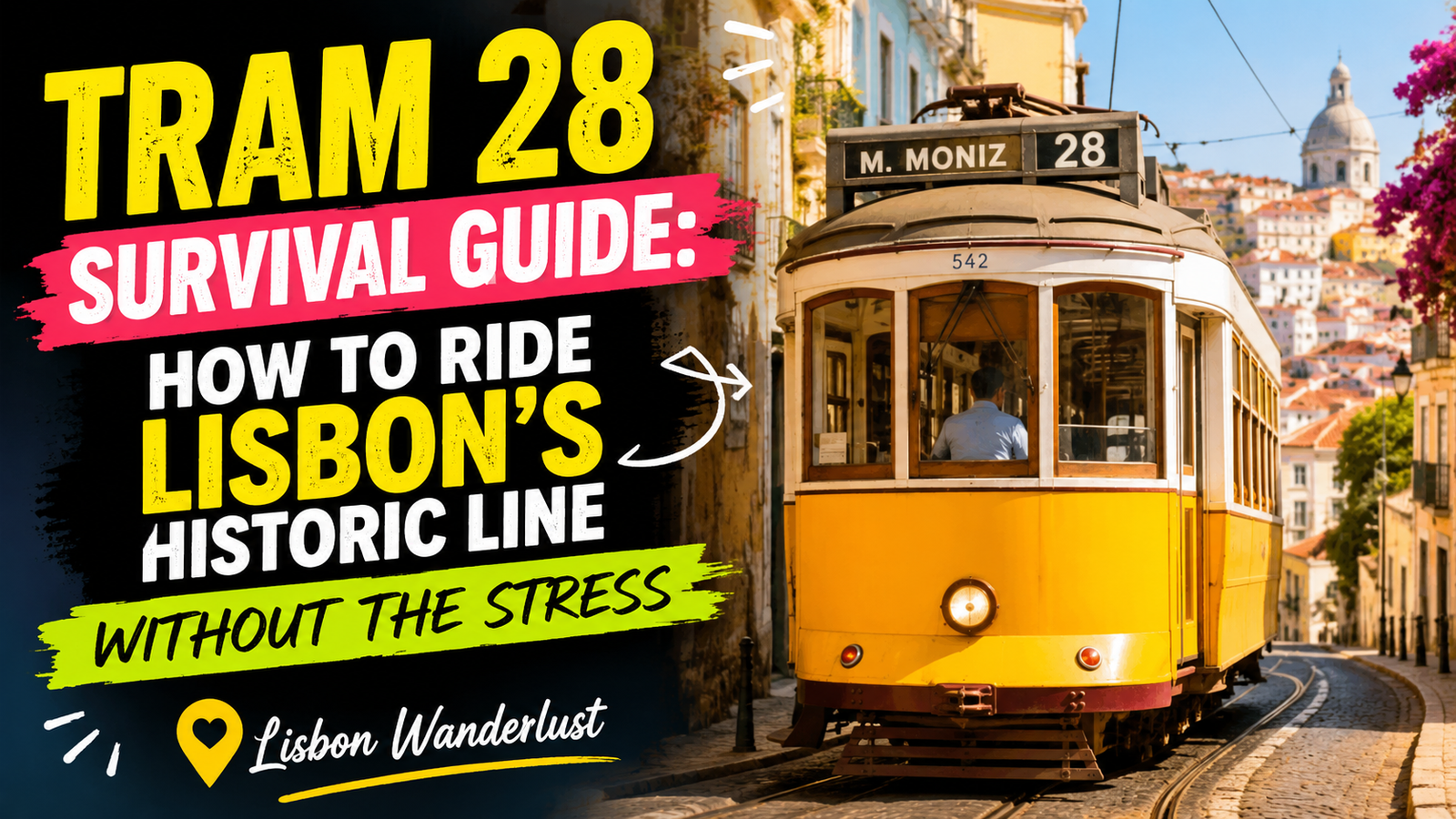
Tram 28 Survival Guide: How to Ride Lisbon’s Historic Line Without the Stress
Tram 28—officially known as the 28E line operated by Carris—is one of Lisbon’s most studied urban transit corridors, not for its scale but for its complexity. Running through some of the oldest and most topographically constrained districts in the city, the line navigates gradients, ქუჩები, and البناء patterns that predate modern transport engineering. What appears to be a simple heritage ride is, in reality, a ضغط-tested system balancing اليومية commuter demand with intense global tourism.
This guide approaches Tram 28 as a functional infrastructure system, not a sightseeing cliché. It examines the technical design of the Remodelado trams, the operational logic behind Lisbon’s ticketing ecosystem, and the behavioral patterns that determine whether a journey becomes efficient or chaotic.
By combining engineering context, маршрут-level analysis, and data-driven boarding strategies, the objective is to transform an unpredictable experience into a controlled, repeatable process—one that reflects how the line is actually used, rather than how it is typically marketed.
Must to See in Lisbon: 21 Top Sights in Lisbon
Discover Lisbon’s most iconic landmarks, hidden gems, and must-visit attractions in one complete guide.
Explore Guide →The Engineering Heritage of Tram 28
The Remodelado Class: Engineering for an Impossible City
Lisbon’s enduring reliance on the Remodelado-class tramcars is not an exercise in nostalgia—it is a direct response to extreme urban engineering constraints. The historic core of the city, particularly across districts like Alfama and Graça, presents gradients and curvature profiles that exceed the operational tolerances of modern light rail systems.
Key constraints:
- Maximum gradients: Up to 13.5% incline in sections such as Calçada da Graça
- Minimum turning radius: Approximately 9 meters in tight corners like Rua das Escolas Gerais
- Street width limitations: Often under 6 meters, shared with pedestrians and delivery traffic
Modern articulated trams require broader turning radii (typically 20–25 meters) and more gradual slopes to ensure stability and passenger safety. Attempting to deploy contemporary rolling stock in these conditions would result in derailment risks, excessive wheel wear, and braking inefficiencies.
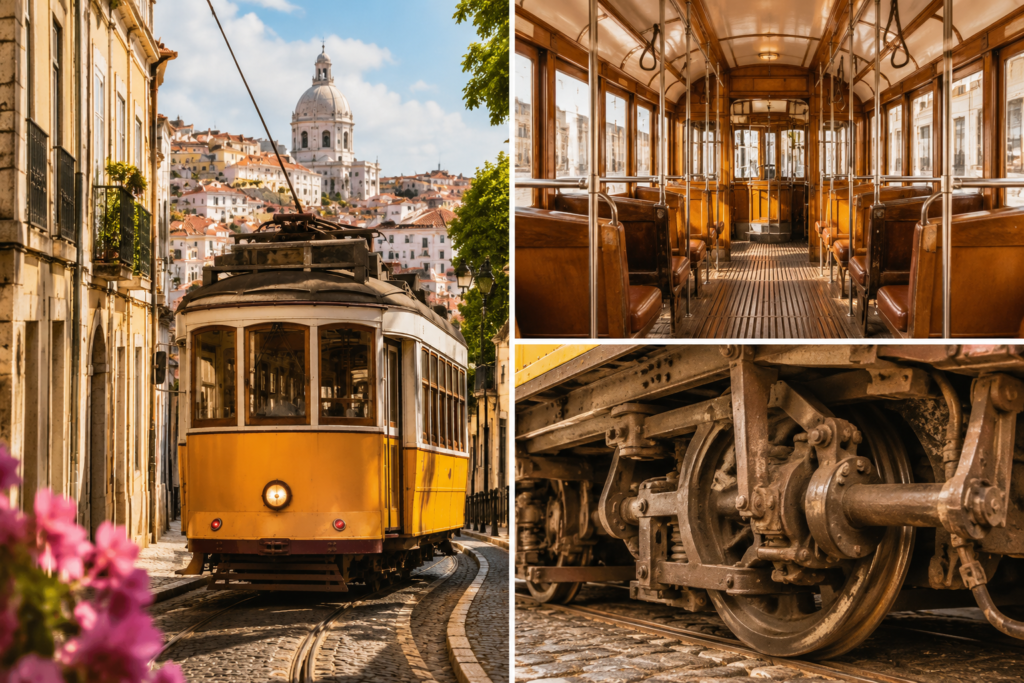
The Remodelado trams—rebuilt during the 1990s using original 1930s chassis—are uniquely suited to this environment. Their compact, four-wheel design, short wheelbase, and reinforced suspension allow them to navigate abrupt elevation changes and hairpin turns with precision.
Technical Specs: Remodelado Tram
- Original build era: 1930s (extensively modernized in the 1990s)
- Operator: Carris
- Length: ~8.5 meters
- Width: ~2.4 meters
- Capacity: ~58 passengers (seated + standing)
- Traction system: Electric motors powered via overhead catenary
- Braking system: Combination of electromagnetic track brakes and manual controls
- Configuration: Single-unit, bi-directional capability via terminal loops
One of the most critical adaptations is the electromagnetic braking system, which supplements traditional mechanical brakes. When descending steep gradients, magnetic track brakes engage directly with the rails, ensuring controlled deceleration even under wet conditions—a frequent scenario in Lisbon’s Atlantic climate.
The interiors retain varnished wood paneling and bench seating, but beneath the surface lies upgraded electrical wiring, improved motor efficiency, and modern safety redundancies. This hybridization—historic shell with contemporary engineering—explains the system’s longevity.
Historical Timeline: From Utility Network to Scenic Icon
The Lisbon tramway network, operated by Carris, dates back to 1873, initially launched as a horse-drawn system known as the “carros americanos.” Electrification began in 1901, transforming the network into one of Europe’s earliest electric tram systems.
During the early 20th century, the tram grid expanded rapidly, eventually exceeding 30 lines and forming the backbone of Lisbon’s urban mobility. However, the mid-century shift toward buses and private automobiles led to widespread route closures. By the 1990s, only a handful of lines remained operational.
Line 28 (Eléctrico 28E) survived this contraction due to its topographical indispensability. Unlike flatter corridors that could be replaced by buses, the steep, labyrinthine streets of Alfama and Graça required rail-bound traction and compact vehicles.
Over time, Line 28 evolved from a functional commuter route into Lisbon’s most recognizable transit experience. Its alignment unintentionally connects a sequence of historically dense districts:
- Graça: Elevated viewpoints and residential hillsides
- Alfama: Medieval street grid and Moorish-era layout
- Baixa: Post-1755 earthquake reconstruction zone
- Chiado: Cultural and literary center
- Estrela / Campo de Ourique: Late 19th-century expansion areas
This continuous cross-section of Lisbon’s urban history—compressed into a single tram line—transformed 28E into what transport planners now describe as a “linear heritage corridor.”
Despite its global popularity, Line 28 remains an active public transit route. Residents rely on it for daily mobility, particularly in districts where alternative transport modes remain impractical. This dual identity—working infrastructure and cultural artifact—defines its operational complexity today.
The Logistics of Lisbon Transit
The Ticketing Ecosystem: Understanding the Navegante / Viva Viagem System
Lisbon’s public transport operates on a stored-value, multi-modal ticketing framework designed for interoperability across trams, buses, metro, and select suburban trains. The system is built around a reusable smart card commonly referred to as Viva Viagem (also branded under the broader Navegante network).
These cards are not optional—they are the primary access mechanism for efficient transit use.
Core characteristics:
- Card cost: ~€0.50 (non-refundable, valid for 1 year)
- Reloadable formats: Zapping credit or time-based passes
- Compatibility: Trams, buses, metro, elevators (funiculars), and some rail lines
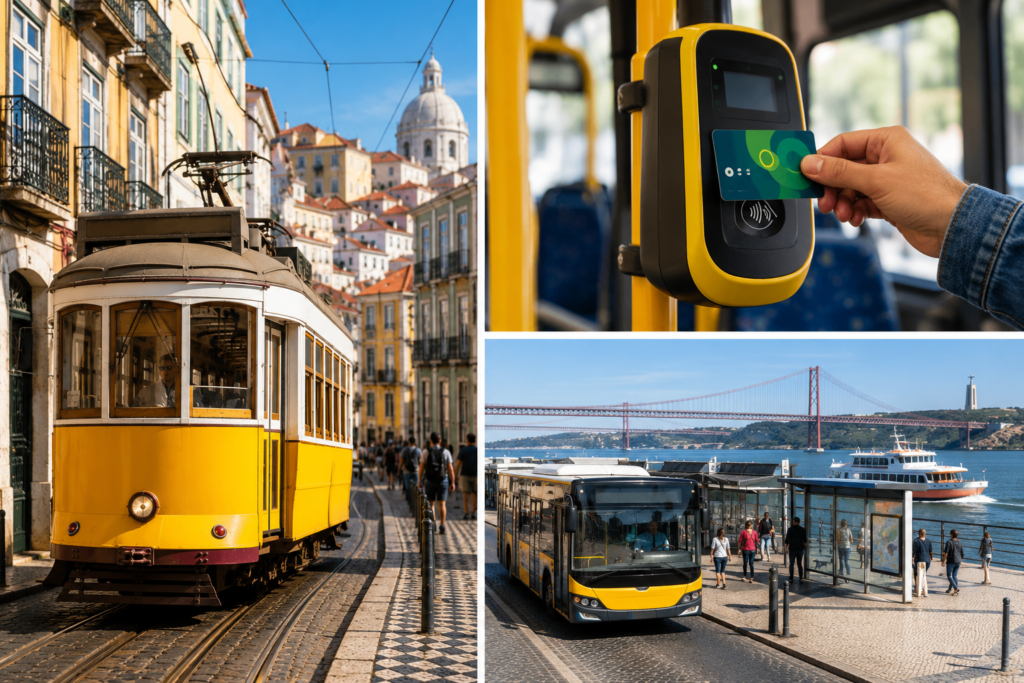
- Validation system: Contactless tap on entry
The system is designed to eliminate onboard cash dependency and reduce dwell time at stops. Each passenger must carry an individual card; sharing is not permitted due to validation tracking.
Zapping vs. 24-Hour Pass vs. Lisboa Card (Cost-Benefit Analysis)
The Lisbon fare structure offers three primary payment strategies, each optimized for different usage patterns.
1. Zapping (Stored Credit Model)
Zapping involves loading a monetary balance onto the Viva Viagem card and deducting fares per ride.
Pricing characteristics:
- Tram 28 fare (zapping): ~€1.50 per trip
- Discounted vs. onboard purchase: ~40–50% cheaper
- Flexibility: Pay only for what is used
Best for:
- Low-frequency riders
- Travelers combining walking with occasional transit
- Short stays with minimal daily rides
2. 24-Hour Unlimited Pass (Carris/Metro Network)
This pass provides unlimited travel within a 24-hour window across the Carris network and metro system.
Pricing characteristics:
- Cost: ~€6.80 per 24 hours
- Coverage: Trams (including 28E), buses, metro, funiculars
- Activation: Begins at first validation
Break-even analysis:
- Becomes cost-effective after 4–5 tram rides or mixed-mode usage
Best for:
- High-intensity sightseeing days
- Travelers planning multiple tram hops
- Avoiding repeated ticket validation decisions
3. Lisboa Card (Tourist Integration Pass)
The Lisboa Card bundles public transport access with free or discounted entry to major attractions.
Pricing characteristics:
- 24-hour version: ~€20+
- Includes: Unlimited transport + museum/site access
- Added value: Skip-the-line privileges at select landmarks
Trade-off:
- Higher upfront cost requires active use of included attractions to justify value
Best for:
- Culture-focused itineraries
- Museum-heavy schedules
- First-time visitors optimizing attraction access
Onboard Constraints: Validation, Penalties, and System Mechanics
The Lisbon system operates on a proof-of-validation model, meaning passengers must validate their card at the start of each यात्रा. Failure to do so is treated as fare evasion, even if the card holds valid credit.
Boarding Workflow (Tram 28 Specific)
- Enter through designated doors (typically front or rear depending on stop conditions)
- Locate the yellow validator machine
- Tap the Viva Viagem card
- Wait for:
- Green light + audible beep = successful validation
- Red light = insufficient balance or invalid pass
Validation timestamps are recorded electronically and may be inspected by transit officers.
Cash Purchase Penalty (Onboard)
While technically possible, purchasing a ticket directly from the driver is strongly discouraged.
Key limitations:
- Price: ~€3.00 per ride (double the zapping fare)
- Exact change often required
- Slows boarding process
- Not always available during peak congestion
This pricing structure is intentionally designed to incentivize preloaded cards and maintain operational efficiency.
System Constraints That Impact Tram 28 Specifically
- Single-door bottlenecks increase boarding time
- Manual driver interaction for cash disrupts schedule adherence
- High passenger turnover requires rapid validation compliance
Because Tram 28 operates in narrow corridors with limited passing opportunities, any delay at boarding propagates across the entire line. This is why seasoned riders treat ticket validation as a pre-boarding requirement rather than an afterthought.
Strategic Navigation & Boarding Science
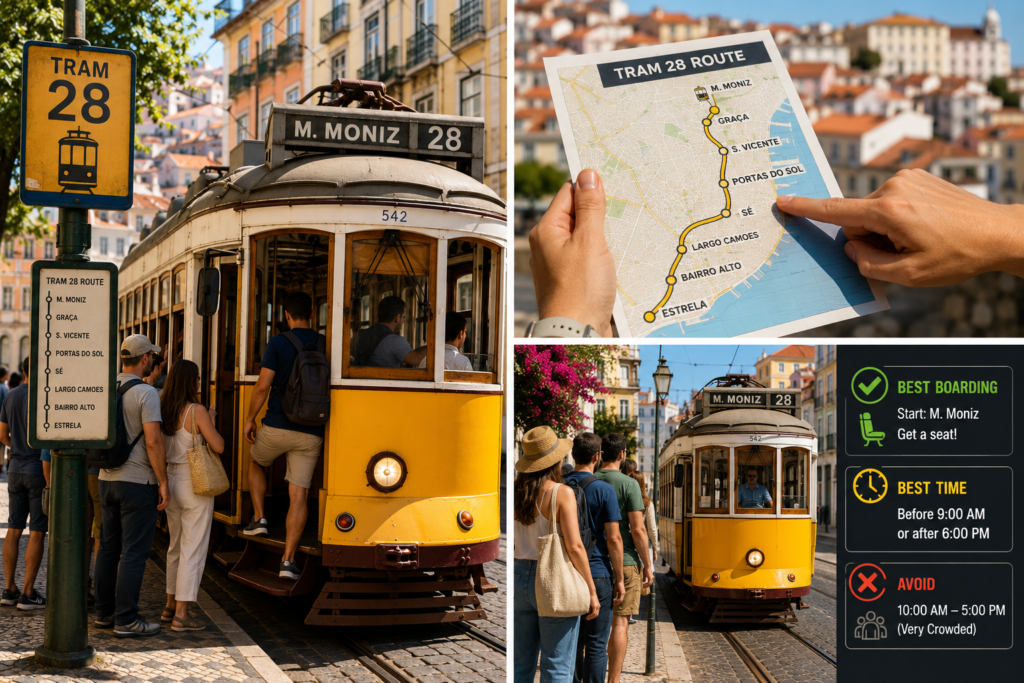
The Terminal Paradox: Why Starting Point Determines the Entire Experience
Tram 28 operates between two terminal loops:
- Martim Moniz (eastern terminus)
- Campo de Ourique / Prazeres (western terminus)
At first glance, Martim Moniz appears to be the logical starting point due to its central location. However, passenger flow data and observed boarding patterns reveal a clear asymmetry.
Martim Moniz: High Demand, Low Seating Probability
- Primary tourist entry point
- Immediate proximity to Baixa and Alfama
- Queue lengths frequently exceed 30–60 minutes during peak season
- Trams often depart at full standing capacity
Because most guidebooks and hotel concierges direct visitors here, demand is artificially concentrated. By the time a tram departs, nearly all seats are occupied, eliminating the possibility of a full-route seated journey.
Campo de Ourique: Lower Demand, Higher Yield Strategy
The western terminus near Prazeres Cemetery operates under significantly different conditions:
- Primarily residential catchment area
- Lower tourist awareness
- Higher probability of boarding an empty or near-empty tram
Data-driven advantage:
- Up to 70–90% chance of securing a seat when boarding at origin
- Minimal queueing outside peak commuter hours
This creates what transit analysts refer to as a “reverse-flow advantage.” By starting at Campo de Ourique and riding eastbound, passengers move against the dominant tourist surge, maximizing comfort and visibility.
Peak Flow Analysis: When the System Breaks Down
Tram 28 experiences two overlapping demand cycles:
1. Commuter Peak
- 07:30 – 09:30
- 17:00 – 19:00
- Local residents using the tram as primary transport
2. Tourist Surge Window
- 10:30 – 16:30
- High-density boarding at Martim Moniz, Alfama, and Graça
Critical Overlap Period (Highest Congestion Risk)
- 11:30 – 14:30
During this window:
- Tourist volume peaks
- Residual commuter movement still active
- Trams reach maximum crush capacity
Operational impact:
- Increased dwell time at stops
- Reduced frequency due to line congestion
- Higher pickpocket risk due to density
Optimal Boarding Windows (Lowest Stress)
- Early morning: 07:00 – 08:30 (before tourist influx)
- Late evening: 20:00 – 22:30 (post-dinner lull)
These windows provide:
- Reduced queue times
- Better seating probability
- More stable travel speeds
Station Strategy: Distributed Boarding vs. Centralized Queues
The majority of passengers cluster at 3 high-visibility stops:
- Martim Moniz
- Praça da Figueira
- Portas do Sol (Alfama viewpoint)
This creates artificial congestion while other stops along the route remain underutilized.
High-Efficiency Boarding Points (Lower Competition)
Estrela (Basílica da Estrela area):
- Balanced passenger turnover
- Wide pavement allows easier boarding
- Close to western terminus flow
Graça (near Largo da Graça):
- Elevated district with multiple tram passes
- Lower queue density than Alfama core
Campo de Ourique intermediate stops:
- Often overlooked by tourists
- Higher likelihood of partial seat availability
Tactical Boarding Method
- Avoid terminal queues when possible
- Position at mid-route stops where:
- Passengers disembark
- Tram occupancy temporarily drops
- Board immediately after alighting passengers exit
- Move quickly to rear seating zones (less contested than front benches)
Micro-Positioning Inside the Tram
Once onboard, positioning affects both comfort and visibility:
- Rear section: Slightly less crowded, better stability
- Window seats: Limited but critical for photography and airflow
- Standing zones near doors: Highest turnover, best for short segments
Because the tram uses abrupt braking (see Section 5), passengers standing in aisles must maintain three-point contact (handrail + stable footing).
Queue Psychology and Behavioral Patterns
- Tourists tend to wait for the next empty tram, even when none are scheduled
- Locals board immediately, regardless of crowding
- Hesitation at doors increases boarding delays and reduces seat access
Experienced riders treat Tram 28 as a dynamic system, not a fixed sightseeing ride. Success depends on adapting to flow patterns rather than following static advice.
The Neighborhood-by-Neighborhood Anatomy
Tram 28 is not a conventional route; it functions as a მოძრავი cross-section of Lisbon’s urban evolution. Over approximately 7 kilometers, the line traverses districts shaped by different historical eras, architectural logics, and topographical constraints. Each segment introduces distinct spatial conditions that directly affect ride dynamics, visibility, and passenger experience.
Graça: Elevated Origins and Panoramic Geometry
The eastern ascent into Graça marks one of the most technically demanding segments of the route. Streets such as Calçada da Graça combine steep gradients with tight curvature, requiring constant modulation of traction and braking.
Urban characteristics:
- Late medieval expansion beyond the original city walls
- Broad viewpoints (miradouros) overlooking the Tagus River
- Mixed residential fabric with local commerce
Operational note:
- Slower tram speed due to incline + pedestrian density
- Frequent boarding/alighting activity
From this elevation, passengers gain early visual access to Lisbon’s layered topography—an important orientation point before descending into Alfama.
Alfama: Medieval Density and the “Alfama Squeeze”
Alfama represents the oldest continuously inhabited district in Lisbon, with a street network that predates modern urban planning. The tram’s passage through Rua das Escolas Gerais is widely regarded as the most technically constrained segment of the entire route.
The “Alfama Squeeze”
- Street width narrows to near-minimum clearance
- Buildings appear within centimeters of tram sides
- Pedestrian interaction becomes unavoidable
This section demands low-speed precision driving, often accompanied by audible warnings from the operator. External mirrors nearly align with balconies and doorframes, illustrating the extreme spatial compression.
Key Landmark: Lisbon Cathedral
- Located along Largo da Sé
- Romanesque structure dating to the 12th century
Best viewing position:
- Right-hand side when traveling from Graça toward Baixa
The tram curves tightly in front of the cathedral, creating a brief but optimal viewing corridor.
Baixa: Rational Grid and Post-Earthquake Reconstruction
Emerging from Alfama, the tram enters Baixa—the only section of the route built on a rational grid system. This district was reconstructed after the 1755 Lisbon earthquake, introducing wide streets and uniform building facades.
Urban characteristics:
- Orthogonal street layout
- Neoclassical architecture
- Commercial and administrative center
Operational shift:
- Increased tram speed due to wider ქუჩები
- Smoother ride quality
- Higher passenger turnover
Chiado: Cultural Core and Vertical Transitions
Chiado introduces a hybrid landscape—part commercial hub, part cultural district—with significant elevation changes. Streets like Rua do Carmo connect lower Baixa to upper Bairro Alto through steep inclines.
Defining elements:
- Historic theaters and literary cafés
- High pedestrian density
- Transitional topography between flat and elevated zones
The tram navigates these gradients using controlled acceleration and braking cycles, often pausing due to pedestrian crossings.
Landmark Visibility: Brazilian Consulate Area
- Located within the Chiado district
Best viewing position:
- Left-hand side when traveling westbound
This segment provides broader street visibility compared to Alfama, allowing clearer sightlines for architectural observation.
Estrela: Spatial Relief and Monumental Architecture
After the density of Chiado, the tram enters Estrela, where the ქუჩები widen and green spaces become more prominent. This district represents 19th-century urban expansion beyond Lisbon’s historic core.
Key Landmark: Basílica da Estrela
- Prominent neoclassical basilica with a large سفید dome
Best viewing position:
- Right-hand side when approaching from Chiado
The tram passes directly in front of the basilica, offering one of the few unobstructed architectural views along the route.
Environmental shift:
- Reduced ساختمان density
- Presence of gardens (e.g., Jardim da Estrela)
- Lower ტურისტ congestion compared to Alfama/Baixa
This section provides a temporary decompression zone before the route terminates.
Campo de Ourique: Terminal Logic and Residential Stability
The western terminus at Prazeres Cemetery / Campo de Ourique represents a fully residential পরিবেশ with minimal tourist infrastructure.
Characteristics:
- Wide streets relative to earlier segments
- Predictable passenger flow
- পরিষ্কার boarding conditions
This is where the tram resets operationally:
- Passenger load drops
- Driver prepares for return loop
- Boarding conditions stabilize
Spatial Transition Summary
Across its full route, Tram 28 moves through five distinct urban systems:
| District | Street Pattern | Density Level | Ride Condition |
|---|---|---|---|
| Graça | Irregular, steep | Medium | 🐢 Slow, climbing |
| Alfama | Medieval labyrinth | Very High | ⚠️ Extremely constrained |
| Baixa | Structured grid | Medium | ⚡ Faster, smoother |
| Chiado | Hybrid vertical | High | ⏸️ Stop-start movement |
| Estrela | Open layout | Low | 🌿 Stable, low stress |
FAQ
Are there luggage size restrictions on Tram 28?
Yes—though not formally published, practical ограничения are strict due to spatial constraints.
Large suitcases (checked-baggage size) are effectively incompatible
Aisles are narrow and կանգնած space is limited
Bags must not block movement or doorways
Recommended:
Use only small backpacks or compact carry-ons
For airport transfers, rely on metro, taxi, or the 15E line instead
Is Tram 28 accessible for strollers or wheelchairs?
No. The Remodelado ترام cars are not منخفض-floor vehicles.
Barriers include:
High քայլ entry (عدة steps)
Narrow داخلی aisles
No designated wheelchair пространства
For accessible transit:
Use modern lines such as the 15E articulated trams
Metro system offers significantly better accessibility coverage
What is the best time for low-light photography?
Lighting conditions along the route vary due to building density and street orientation.
Optimal windows:
Early morning (07:00 – 09:00) Soft directional light in Graça and Alfama
Minimal crowd interference
Golden hour (17:30 – 19:30, seasonal) Warm tones across Estrela and Chiado
أفضل contrast on façades and tram اللون الأصفر
Night (after 21:00) Lower пассажир density
Ideal for interior shots and illuminated streets
How long does the full route take?
End-to-end duration: ~40–60 minutes
Dependent on: Passenger load
Traffic interference
Boarding delays
During peak congestion, total journey time can exceed 70 minutes
Is it necessary to ride the entire route?
No. উচ্চ-value strategy involves segmenting the journey:
Ride Graça → Alfama → Baixa for historic density
Ride Chiado → Estrela for architectural contrast
Skip overcrowded segments if الهدف is efficiency
The Low-Stress Execution Framework (Actionable Summary)
This framework converts the entire guide into a repeatable system.
1. Pre-Boarding Setup
- Purchase Viva Viagem card
- Load with:
- Zapping credit or
- 24-hour unlimited pass
2. Boarding Strategy
- Avoid Martim Moniz queues
- Start at:
- Campo de Ourique (best option)
- Or mid-route stops like Estrela
3. Timing Optimization
- Target:
- 07:00–08:30 (best overall)
- 20:00+ (lowest crowd density)
- Avoid:
- 11:30–14:30 peak overlap window
4. Positioning Logic
- Sit on:
- Right side → Sé Cathedral, Estrela Basilica
- Left side → Chiado दृश्य zones
- Prefer rear section for stability
5. Risk Control
- Keep belongings:
- সামনে-facing
- Zipped and secured
- Maintain awareness during:
- Boarding
- Door կանգնած zones
6. Experience Optimization
- Do not treat as a continuous ride
- उतर and re-board strategically
- Combine with:
- 12E (Alfama loop)
- Funiculars for steep climbs
Final Operational Insight
Tram 28 functions as a high-friction transit system operating within extreme urban constraints. यात्रियों who approach it as a passive tourist attraction often encounter:
- Long queues
- Overcrowded interiors
- Reduced visibility
By contrast, those who apply transit logic—timing, positioning, and համակարգ awareness—convert the same system into a controlled, উচ্চ-value تجربة.
The difference is not the tram itself, but the strategy applied to riding it.