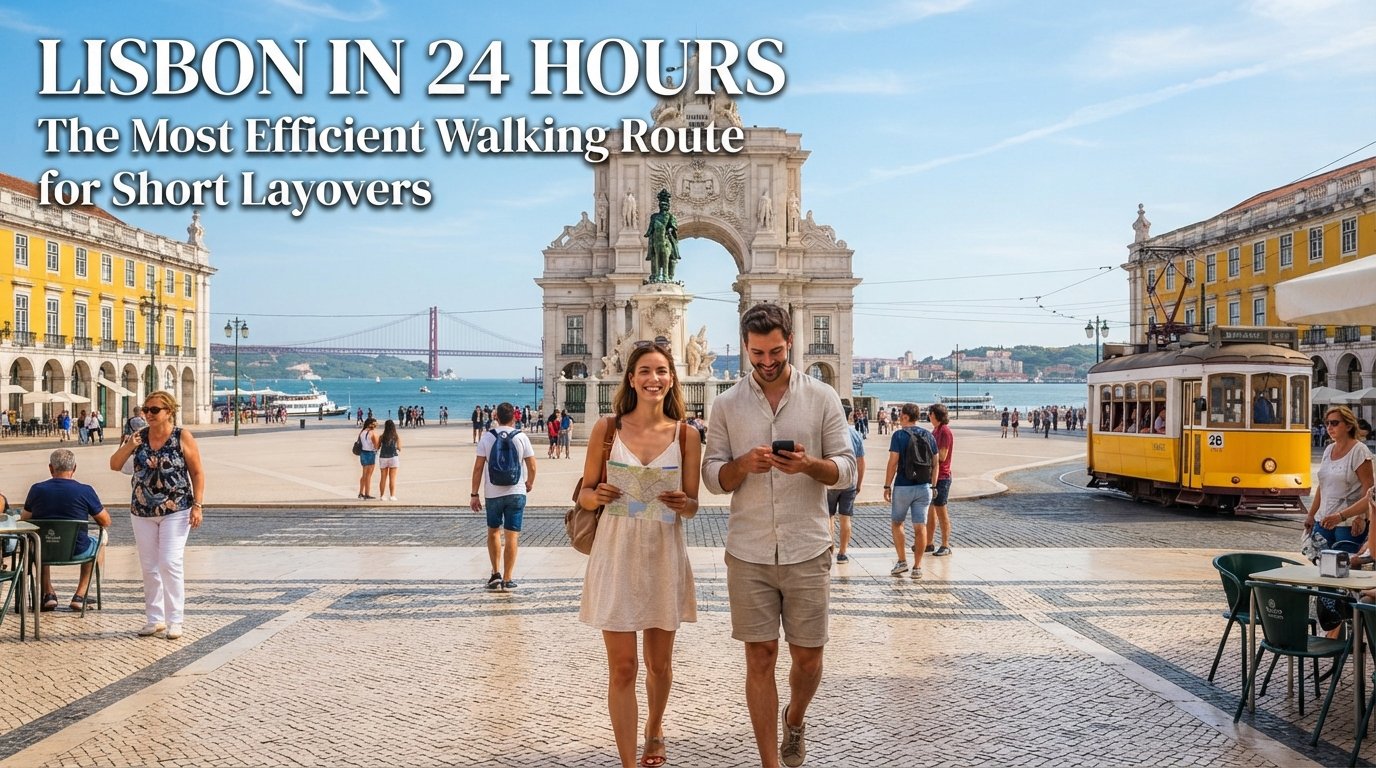
Lisbon in 24 Hours: The Most Efficient Walking Route for Short Layovers
Lisbon can be seen in 24 hours, but only with a focused route. Best plan: stay around Baixa, Chiado, Alfama, and nearby viewpoints instead of rushing across every famous attraction.
This guide gives a practical Lisbon walking route for short layovers, cruise stops, and one-day visits. It covers what to see, what to skip, where to save time, and how to avoid wasting energy on steep streets or long transport detours.
For most travelers, Praça do Comércio works best as a starting point. Lisbon Airport also connects to central Lisbon by metro, and Lisbon Airport’s official transport page says the Aeroporto–Saldanha metro route takes about 20 minutes, which makes a short city visit realistic when layover timing allows it.
Belém, Jerónimos Monastery, and Belém Tower are worth seeing, but they do not fit every 24-hour walking route. They need extra transport time, so this guide keeps Belém as an optional detour rather than forcing it into the main route.
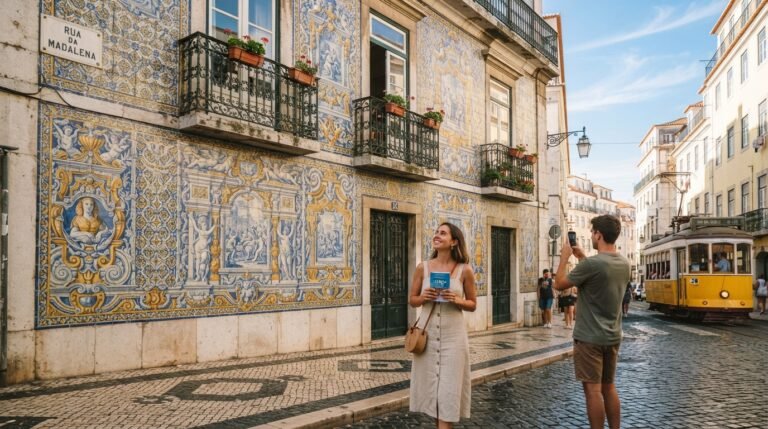
Read More: Aesthetic Lisbon: 10 Pastel Streets That Look Like a Postcard
Quick Answer: Best 24-Hour Lisbon Walking Route
Best 24-hour Lisbon route: start at Praça do Comércio, walk through Rua Augusta and Baixa, continue to Chiado and Carmo, then move toward Lisbon Cathedral, Alfama, Santa Luzia, Portas do Sol, and end near Cais do Sodré, Time Out Market, Chiado, or Bairro Alto.
This route works because it follows Lisbon’s historic center in a natural order. It avoids long backtracking, keeps major sights close together, and leaves room for food, photos, viewpoints, and rest stops.
Praça do Comércio makes a strong first stop because it sits beside the Tagus River and gives easy access to Rua Augusta, Baixa, Lisbon Story Centre, and nearby central streets. Visit Lisboa describes Praça do Comércio as one of Lisbon’s most emblematic squares and a key gateway to nearby attractions.
Total walking time depends on pace, breaks, and optional stops. A realistic route needs around 4 to 6 hours of walking and sightseeing, plus meal breaks and transport time.
Lisbon in One Day Walking Route
Use this simple route to explore Lisbon’s main highlights in one day without wasting time moving back and forth across the city.
| Time | Area | What to Do | Walking / Transport Note | Why It Matters |
|---|---|---|---|---|
| 8:30 AM | Praça do Comércio | Start by the river and see Arco da Rua Augusta area. | Flat, easy start. | Best orientation point for first-time visitors. |
| 9:00 AM | Rua Augusta + Baixa | Walk the main pedestrian streets. | Simple grid layout. | Quick way to feel central Lisbon. |
| 10:00 AM | Santa Justa / Carmo | See the lift area, Carmo square, and ruins from outside or inside. | Short uphill sections. | Good history stop without leaving the center. |
| 11:30 AM | Chiado | Take coffee, browse shops, and enjoy an easy break. | Moderate walking. | Smart rest point before Alfama hills. |
| 1:00 PM | Lisbon Cathedral | Walk toward the Sé area. | Some uphill streets. | Best gateway into older Lisbon. |
| 2:00 PM | Alfama | Wander the narrow lanes slowly. | Steep and uneven. | Classic Lisbon neighborhood atmosphere. |
| 3:00 PM | Santa Luzia Viewpoint | Stop for a short viewpoint break. | Uphill, cobblestones. | One of the easiest scenic stops in Alfama. |
| 3:30 PM | Portas do Sol | Take photos, rest, and enjoy river views. | Close to Santa Luzia. | Strong viewpoint without extra detour. |
| 4:00 PM | Optional Castle | Visit only if time and energy allow. | Steep climb or nearby elevator route. | Best for travelers who want deeper history. |
| 6:00 PM | Cais do Sodré / Chiado | Choose dinner or a market-style meal. | Walk downhill or use transport. | Easy ending near metro, train, and nightlife. |
| Evening | Bairro Alto or Viewpoint | Enjoy a final walk, drink, sunset, or return. | Keep the route flexible. | Good ending without overloading the day. |
Most travelers should not ride Tram 28 if queues are long. It may look like a perfect one-day Lisbon activity, but waiting too long can eat into a short layover.
Castelo de São Jorge can fit into this route, but only as an optional stop. The official castle site says it opens daily with seasonal schedule details and last-admission rules, so travelers should check current hours before building plans around it.
Best short-layover rule: choose fewer stops and enjoy them properly. Lisbon rewards slow walking, clear timing, and smart shortcuts more than a packed checklist.
Is 24 Hours Enough for Lisbon?
Yes, 24 hours can work for Lisbon if the route stays focused. One day gives enough time for Baixa, Chiado, Alfama, river views, viewpoints, simple food stops, and a strong first look at the city.
What 24 hours cannot do: Lisbon, Belém, Sintra, every museum, every viewpoint, and long restaurant breaks in one smooth plan. Cramming too much into one day usually turns the visit into transport, queues, and tired legs.
Best one-day Lisbon plan follows a simple rule: see the historic center well, then add one optional detour only if time allows. Baixa, Chiado, and Alfama sit close enough for a self-guided walking route, while Belém needs transport and extra planning.
Lisbon also has hills, stairways, and slippery cobblestone streets. A route may look short on a map but feel harder in real life, especially between Baixa, Alfama, and castle areas.
For short layovers, allow enough buffer for airport return, security, luggage, and traffic. Lisbon Airport’s official transport guidance says the metro route between Aeroporto and Saldanha takes about 20 minutes, but airport timing still needs extra margin.
A good 24-hour Lisbon itinerary should not chase every famous attraction. It should connect easy wins: a grand square, historic streets, one or two viewpoints, a local food stop, and a flexible ending near transport.
Best use of 24 hours in Lisbon:
- Stay in central Lisbon
- Start early
- Walk downhill when possible
- Keep Belém optional
- Skip long lines
- Use metro, tram, taxi, or rideshare only when it saves real time
- Leave space for breaks because Lisbon walking can tire people quickly
Travelers with a full day can follow the full route. Travelers with only 6 to 8 hours should keep Praça do Comércio, Baixa, Chiado, Lisbon Cathedral, Alfama, and one viewpoint.
Sintra should not be added to a 24-hour Lisbon plan unless Lisbon itself has already been seen before. Sintra needs a separate day because transport, palace visits, and queues can swallow most of a short trip.
You might be interested in: 7 Best Miradouros in Lisbon for Sunset (With Exact Locations)
Before You Start: Key Lisbon Travel Logistics
A smooth 24-hour Lisbon route starts before the first step. Bags, shoes, transport, and timing matter more than adding one more stop.
Getting from Lisbon Airport to the City Center
Lisbon Airport sits close to central Lisbon compared with many European capitals. The metro connects the airport with the city network, and official airport guidance lists Aeroporto–Saldanha at about 20 minutes.
For most short-stay travelers, metro works well when bags are light and timing feels relaxed. Taxis or rideshare can save effort with luggage, late arrivals, or tight layovers, but traffic can change travel time.
Metro Lisboa also publishes current fares, maps, line status, and ticket information on its official site. The Carris/Metro occasional ticket and 24-hour ticket details can change, so check the latest fare page before travel.
Luggage Storage
Do not walk Alfama or Chiado with large luggage. Narrow sidewalks, stairs, and cobblestones make rolling bags frustrating fast.
Use luggage storage near Baixa-Chiado, Rossio, Cais do Sodré, or the airport area if needed. Some private luggage-locker companies list central Lisbon options near Baixa-Chiado and Rossio, but hours and prices should be checked before booking.
Shoes and Walking Difficulty
Wear comfortable shoes with grip. Lisbon’s cobblestone streets can feel slippery, especially after rain.
Baixa feels mostly flat, but Alfama, Graça, and castle routes climb quickly. A short uphill walk can feel longer than expected because many streets rise sharply and include steps.
Best Time to Start
Start early if possible. Morning gives quieter streets, easier photos, cooler weather, and more room for flexible stops.
Late starters should cut one major item. Best cuts are usually Castelo de São Jorge, Belém, or long sit-down lunch.
Transport Backup Plan
Do not treat the route as walking-only at all costs. Lisbon has metro, buses, trams, elevators, funiculars, taxis, and rideshare options, and smart transport use can save energy.
Good backup points include Baixa-Chiado, Rossio, Terreiro do Paço, Martim Moniz, Santa Apolónia, and Cais do Sodré. These areas help travelers shorten the route or return toward airport, hotel, train, or cruise terminal.
Tickets, Hours, and Attraction Rules
Check official attraction pages before entering paid sights. Opening hours, last entry, holidays, restoration work, and ticket rules can change without fitting neatly into travel blogs.
For a one-day visit, do not build the route around a paid attraction unless its current hours are confirmed. Outdoor stops, viewpoints, squares, and neighborhood walks give more flexibility.
Safety and Common Sense
Central Lisbon is generally easy for visitors, but busy tourist areas need normal city awareness. Keep phones, wallets, and passports secure around trams, viewpoints, queues, and crowded streets.
Late-night walking feels better in busier areas such as Chiado, Cais do Sodré, and main streets. Quiet stairways and empty alleys are easier to skip when returning alone or carrying bags.
Quick Pre-Walk Checklist
- Phone charged
- Offline map saved
- Comfortable shoes on
- Water bottle packed
- Bags stored
- Airport or hotel return route checked
- Attraction hours checked
- Meal stop chosen loosely
- Backup transport option ready
A little planning saves a lot of stress in Lisbon. As the saying goes, “measure twice, cut once,” and that fits a short layover perfectly.
Explore: The Ultimate 3-Day Lisbon Itinerary: A Factual, Hour-by-Hour Route
The Most Efficient Lisbon Walking Route for 24 Hours
A strong 24-hour Lisbon walking route should move in one clear direction: Praça do Comércio → Baixa → Chiado → Carmo → Lisbon Cathedral → Alfama → Santa Luzia → Portas do Sol → Cais do Sodré or Bairro Alto.
This route keeps the day simple. It covers Lisbon’s historic center, riverfront, old streets, viewpoints, food areas, and evening spots without forcing long transport gaps.
Stop 1: Praça do Comércio
Start at Praça do Comércio, also called Terreiro do Paço. Visit Lisboa describes it as one of Lisbon’s most iconic squares, and it works well because it opens the city with river views, wide space, and easy access to Baixa.
Spend 20 to 30 minutes here. Walk near the river, look back toward Arco da Rua Augusta, and use the square as the starting line for the day.
Do not spend too long taking photos from every angle. In a one-day Lisbon itinerary, this stop should feel like a clean beginning, not a full morning plan.
Stop 2: Rua Augusta and Baixa
Walk through Arco da Rua Augusta toward Rua Augusta. Visit Lisboa notes that Arco da Rua Augusta has a public viewpoint over the city, but short-stay travelers should only go up if there is no queue and timing feels relaxed.
Baixa is one of the easiest areas for walking because streets follow a flatter grid. This makes it a smart section before Lisbon’s hills begin.
Spend 45 to 60 minutes in Baixa. Walk Rua Augusta, notice side streets, pass shops and cafés, then move toward Rossio or the Santa Justa area.
Stop 3: Santa Justa Lift Area and Carmo
Santa Justa Lift looks tempting, but it often creates a time problem. Visit Lisboa currently marks Elevador de Santa Justa as temporarily closed, so travelers should check current status before adding it to a fixed itinerary.
A better move for many visitors: see the lift from below, then walk toward Largo do Carmo and Carmo Convent area. This saves time and still gives a strong sense of Lisbon’s older architecture.
Spend around 30 to 45 minutes here. If the lift has long queues or limited access, skip the ride and keep walking.
Stop 4: Chiado
Chiado works well as the middle break of the route. It has cafés, shops, bookshops, churches, and easier places to pause before moving into steeper old streets.
This is a good time for coffee, water, a pastry, or a short lunch. Keep the stop simple because Alfama and viewpoints still need energy.
Spend 45 to 60 minutes in Chiado. A relaxed break here makes the afternoon route easier.
Stop 5: Lisbon Cathedral
From Chiado or Baixa, move toward Lisbon Cathedral, also known as Sé de Lisboa. It works as a natural gateway between central Lisbon and Alfama.
The walk starts to feel older and tighter here. Streets become less flat, sidewalks narrow, and tourist traffic can slow movement.
Spend 15 to 30 minutes around the cathedral area. Enter only if opening times, ticket rules, and time allow; otherwise, use it as a clear landmark before Alfama.
Stop 6: Alfama
Alfama should not be rushed. This old neighborhood has narrow lanes, stairs, laundry balconies, small squares, tiled walls, and turns that feel confusing on purpose.
Spend 60 to 90 minutes here if legs allow. Walk slowly, follow map direction loosely, and avoid dragging heavy bags through this area.
The best Alfama strategy is simple: choose one or two viewpoints, not every alley. Trying to cover every corner wastes energy and makes the afternoon harder.
Stop 7: Miradouro de Santa Luzia
Miradouro de Santa Luzia is one of the easiest viewpoint wins in Alfama. Visit Lisboa highlights it for its view and decorative tiles, which makes it useful for travelers who want scenery without adding another long detour.
Spend 15 to 25 minutes here. Take photos, drink water, and rest before moving a little farther uphill or across to Portas do Sol.
This area can get crowded during busy hours. Keep phones and wallets secure because viewpoint crowds make pickpocketing easier.
Stop 8: Miradouro das Portas do Sol
Portas do Sol sits very close to Santa Luzia, so it fits naturally into the route. It gives wider views over Alfama rooftops and the river.
Spend 15 to 25 minutes here. This stop gives a strong Lisbon viewpoint experience without needing a separate taxi ride.
If time is short, choose Santa Luzia or Portas do Sol, not both. If time feels comfortable, both are easy to pair.
Stop 9: Optional Castelo de São Jorge
Castelo de São Jorge is worth adding only with enough time, energy, and current ticket information. The official castle website lists seasonal schedules and last-admission rules, so check before going.
For a 24-hour Lisbon route, the castle is optional because it adds more climbing and takes time inside. Travelers who love history and viewpoints may enjoy it; travelers with tight layovers may prefer Alfama streets and free viewpoints.
Spend 60 to 90 minutes if entering the castle. Skip it if the day already feels rushed.
Stop 10: End Near Cais do Sodré, Time Out Market, Chiado, or Bairro Alto
After Alfama, head back toward Baixa, Cais do Sodré, Chiado, or Bairro Alto depending on energy. Cais do Sodré works well for food, metro, train, riverfront walking, and easy movement.
Time Out Market can be useful for groups because everyone can choose different food quickly. For quieter dinner, Chiado or nearby side streets may feel calmer than crowded food halls.
End the day near transport instead of climbing into another far neighborhood. A good ending saves energy for airport return, hotel check-in, or cruise boarding.
Morning Route: Praça do Comércio to Baixa
Morning should stay simple: riverfront first, Baixa second, coffee or pastry third. This order gives a clean start and avoids Lisbon’s harder hills before legs wake up.
Start at Praça do Comércio
Praça do Comércio gives one of Lisbon’s easiest first views. It faces the Tagus River, connects directly to Rua Augusta, and gives enough open space to understand the city layout.
Arrive early if possible. Morning light, fewer crowds, and cooler air make this area easier for photos and walking.
Spend 20 to 30 minutes here. Walk near the river, look toward the arch, and avoid sitting too long unless the day starts very early.
Walk Through Arco da Rua Augusta
Arco da Rua Augusta marks the entrance from the riverfront into Baixa. It also has a public viewpoint, but one-day travelers should treat it as optional, not required.
If there is no line and time feels open, going up can add a strong city view. If the route feels tight, walk under the arch and continue into Baixa.
Short trips need smart trade-offs. Sometimes seeing a landmark from street level is enough.
Follow Rua Augusta Slowly
Rua Augusta is the main pedestrian street leading through Baixa. It is busy, easy to follow, and helpful for first-time visitors who want a clear walking line.
This is a good place for a quick pastry, coffee, or water stop. Do not choose a long meal here unless the restaurant has strong current reviews and clear pricing.
Keep moving toward Rossio or the Santa Justa area. Baixa is pleasant, but the best one-day Lisbon route needs time for Chiado and Alfama too.
Use Baixa for Easy Orientation
Baixa works like a reset point because its streets are flatter and more organized. If anyone in the group gets tired, this area has metro stations, taxis, cafés, shops, and easier walking.
Look for simple landmarks: Rua Augusta, Rossio, Praça da Figueira, and Santa Justa Lift area. These points help visitors avoid getting lost before heading uphill.
Do not over-shop in the morning. Souvenir browsing can wait until the route returns toward Baixa or Chiado later.
Smart Morning Timing
A good morning pace looks like this:
Lisbon Morning Walking Plan
Start your Lisbon day slowly from the riverfront, then move through Baixa toward Chiado without rushing.
Praça do Comércio
What to do: River view, square, photos.
Time needed: 20–30 minutes
Arco da Rua Augusta
What to do: Walk under the arch, optional viewpoint.
Time needed: 10–30 minutes
Rua Augusta
What to do: Walk, coffee, pastry, light browsing.
Time needed: 30–45 minutes
Baixa / Rossio Side
What to do: Short stop, map check, water break.
Time needed: 15–25 minutes
Santa Justa / Carmo Direction
What to do: Start moving toward Chiado.
Time needed: Flexible
If the morning starts late, skip the arch viewpoint and long café stop. Go straight from Praça do Comércio through Rua Augusta, then continue toward Chiado.
Midday Route: Chiado, Carmo, and Easy Lunch Stop
Midday should slow the pace, not stop the whole route. Lisbon looks small on maps, but hills, crowds, and stone sidewalks make a rushed day feel heavy.
Chiado and Carmo work well after Baixa because they sit close to central streets but feel more elevated and historic. This part of the route gives a clean break before Alfama’s steeper lanes.
Walk from Baixa Toward Carmo
From Baixa, move toward Largo do Carmo. Expect a short climb, so take it slowly instead of racing uphill.
Carmo Convent sits near one of Lisbon’s most memorable squares. Its roofless Gothic ruins are worth considering if time allows, but check current opening details before planning around entry.
For a short Lisbon layover, seeing Carmo from the outside can still work. Paid stops should earn their place in a 24-hour route.
Use Santa Justa Lift Smartly
Santa Justa Lift often attracts long queues because many travelers see it as a shortcut and viewpoint. Visit Lisboa currently notes Santa Justa Lift as temporarily closed, so travelers should check latest status before adding it to a fixed route.
A smart option: view the lift from below, then walk toward Carmo and Chiado. This saves time and avoids building the day around one crowded attraction.
If Santa Justa Lift has reopened and lines are short, it can be a nice bonus. If lines stretch too long, skip it without regret.
Take a Practical Lunch Break in Chiado
Chiado makes a better lunch stop than deep Alfama for many one-day travelers. Streets feel easier, choices are wider, and transport backup stays close.
Keep lunch simple: soup, sandwich, seafood snack, pastelaria meal, market-style food, or a quick local plate. Long meals can push Alfama and viewpoints too late.
Check menus before sitting down near major tourist streets. Clear prices, recent reviews, and steady local traffic usually matter more than a pretty doorway.
What to Eat Without Losing Time
Good short-stay food choices include pastel de nata, bifana, prego, caldo verde, bacalhau dish, grilled fish, or simple petiscos. Travelers who want something fast should choose a café or casual tasca over a full multi-course meal.
Avoid waiting 45 minutes for one “famous” food stop unless food is the main goal. In a 24-hour Lisbon itinerary, time is also a currency.
If lunch happens later, use Chiado only for coffee and water. Then eat properly near Cais do Sodré, Time Out Market, or Bairro Alto in the evening.
Best Midday Route Through Santa Justa, Carmo, and Chiado
Use this midday plan to enjoy central Lisbon without wasting time in long queues or tiring yourself before Alfama.
Santa Justa Area
Best move: View the lift and skip long queues.
Time needed: 10–20 minutes
Largo do Carmo
Best move: See the square, convent area, and take a short rest.
Time needed: 20–40 minutes
Chiado
Best move: Stop for coffee, light lunch, and a little shopping.
Time needed: 45–60 minutes
Baixa / Sé Direction
Best move: Start moving toward Lisbon Cathedral.
Time needed: 20–30 minutes
Do not make midday too heavy. A short break, light food, and clear route toward Lisbon Cathedral will keep the afternoon strong.
Afternoon Route: Lisbon Cathedral, Alfama, and Viewpoints
Afternoon belongs to older Lisbon: Lisbon Cathedral, Alfama, tiled corners, narrow lanes, and river viewpoints. This section gives the route its strongest sense of place.
Do not rush Alfama like a checklist. Slow steps work better here because streets twist, climb, and break into stairs without warning.
Walk Toward Lisbon Cathedral
Lisbon Cathedral, also called Sé de Lisboa, works as a clear landmark before entering Alfama. Visit Lisboa lists seasonal opening hours and notes closure on Sundays and Holy Days, so travelers should check timing before planning an interior visit.
If time feels tight, use the cathedral as a photo and orientation stop. If time feels comfortable, enter only after checking current ticket and schedule details.
The area around the cathedral can get crowded with trams, tuk-tuks, walkers, and tour groups. Keep bags close and cross streets carefully.
Enter Alfama Slowly
Alfama starts near the cathedral and climbs into one of Lisbon’s oldest neighborhoods. Expect uneven paths, small lanes, stairways, viewpoints, tiled houses, and sudden turns.
A good Alfama walk does not need every street. Choose a general direction toward Santa Luzia and Portas do Sol, then let small side lanes add character without pulling the route off track.
Large luggage is a bad match for Alfama. Even small rolling bags can turn a pretty walk into a struggle.
Stop at Miradouro de Santa Luzia
Miradouro de Santa Luzia gives a strong viewpoint without a major detour. Visit Lisboa highlights it for both river views and decorative tile details, which makes it useful for travelers who want beauty plus easy access.
Spend 15 to 25 minutes here. Take photos, drink water, and let legs recover before moving farther.
Crowds often gather near the terrace edge. Keep phones secure and avoid placing bags down for photos.
Continue to Portas do Sol
Portas do Sol sits close to Santa Luzia, so pairing both viewpoints makes sense. It gives a wider look over Alfama rooftops, churches, and the Tagus River.
Spend 15 to 25 minutes here. If weather is hot, use this stop for shade, water, and a slow reset.
If only one viewpoint fits, choose based on crowd level. Santa Luzia feels more decorative, while Portas do Sol feels more open.
Should You Add Castelo de São Jorge?
Castelo de São Jorge can be added after Portas do Sol, but it should stay optional. The official castle website gives current seasonal schedules and visit rules, so check before going uphill or buying tickets.
Add the castle if history, walls, and high viewpoints matter more than food, shopping, or Belém. Skip it if legs feel tired or airport return time feels tight.
A castle visit can take 60 to 90 minutes with walking, entry, photos, and exit. In a short layover, that time may be better spent enjoying Alfama slowly.
Best Afternoon Shortcut
If energy drops after Portas do Sol, head downhill toward Baixa or Cais do Sodré. No shame in cutting a route short; better a smooth day than a forced march.
Use taxi or rideshare from the Alfama or castle area if walking downhill feels hard. Lisbon rewards smart choices, and “better safe than sorry” fits short travel days well.
Best Afternoon Route Through Alfama and Viewpoints
Use this afternoon plan to explore Lisbon Cathedral, Alfama, scenic viewpoints, and the castle option without making the day feel too heavy.
Lisbon Cathedral
Best move: Landmark stop with optional entry.
Alfama
Best move: Take a slow walk through old lanes.
Santa Luzia
Best move: Stop for viewpoint photos and a water break.
Portas do Sol
Best move: Enjoy the wider view and take a rest stop.
Optional Castle
Best move: Enter only if you still have time and energy.
Downhill Return
Best move: Move toward Baixa, Chiado, or Cais do Sodré.
Best afternoon rule: do not fight Lisbon’s hills. Walk when it feels good, pause when needed, and use transport when it saves the day.
Optional Detour: Should You Visit Belém in 24 Hours?
Belém is worth visiting, but it should not be forced into every 24-hour Lisbon walking route. It sits west of central Lisbon, so adding it means using public transport, taxi, or rideshare instead of simply walking from Baixa.
For first-time visitors with one full day, Belém makes sense only if the main city route starts early and stays efficient. For short layovers, cruise stops, or tired travelers, Baixa, Chiado, Alfama, and viewpoints usually give better value with less stress.
Why Belém Takes Extra Planning
Belém has major Lisbon landmarks, including Jerónimos Monastery, Belém Tower, the Discoveries Monument area, museums, riverside walks, and the famous pastel de nata stop. The problem is not quality; the problem is time.
Carris route 15E connects central Lisbon areas such as Praça da Figueira, Praça do Comércio, and Cais do Sodré with Belém stops, including Mosteiro Jerónimos. This makes Belém reachable, but it still adds waiting time, ride time, crowds, and return planning.
If visiting Belém, do not try to walk there from Baixa. It looks tempting on maps because both areas follow the river, but the route is too long for a tight one-day itinerary.
Best Way to Add Belém
Add Belém after the main historic-center walk only if energy and time still feel good. Best practical order is: Baixa or Cais do Sodré → Belém → Jerónimos area → Pastéis de Belém area → riverside walk → return to Cais do Sodré or city center.
Travelers using public transport should check current Carris fares and ticket options before the day begins. Carris lists 2026 occasional ticket options, including a Carris/Metro travel ticket and 24-hour ticket, but prices and rules should always be checked close to travel.
Taxi or rideshare may work better for small groups, late starts, or airport layovers. Paying a little more can save time, and time matters more than a few euros when only 24 hours are available.
What to See in Belém With Limited Time
Keep Belém simple. Choose two or three nearby stops instead of turning it into a second full itinerary.
Best short Belém plan:
- Jerónimos Monastery exterior or timed visit
- Pastéis de Belém area for a quick pastry stop
- Belém riverside walk
- Belém Tower exterior if time allows
- Monument to the Discoveries area if already nearby
Visit Lisboa lists Jerónimos Monastery as a major Belém attraction with current schedule details, so travelers should confirm opening hours before planning an interior visit.
Belém Tower often takes more time than expected because it sits farther along the river from Jerónimos. For short visits, seeing it from outside can be enough.
When to Skip Belém
Skip Belém if the Lisbon day starts after lunch. Also skip it if the route already includes Alfama, viewpoints, castle, dinner, and airport return.
Belém should also be skipped during heavy rain, tight layovers, or very hot afternoons. Good travel planning means knowing when less gives more.
A simple rule works well: if Belém creates stress, skip it. Lisbon’s historic center already gives a full one-day experience.
Evening Plan: Dinner, Sunset, and Final Walk
Evening should feel flexible, not rushed. After Alfama and viewpoints, the best ending depends on energy, weather, and return plans.
Cais do Sodré, Chiado, Bairro Alto, and Baixa all work well for evening. They keep travelers near food, transport, hotels, river walks, and easy exits.
Best Ending Area for Easy Transport: Cais do Sodré
Cais do Sodré is one of Lisbon’s most useful evening areas because it connects metro, train, boat, food, and nightlife in one place. Visit Lisboa describes Cais do Sodré as a central hub where travelers can catch metro, train, or boat services.
This makes it a smart final stop for one-day visitors. It reduces the risk of ending the night far from transport with tired legs.
Cais do Sodré also works well if the route includes a riverside walk. The area feels practical because food and transport sit close together.
Dinner Option: Time Out Market Lisbon
Time Out Market Lisbon can be useful when travelers want a fast dinner with many choices under one roof. The official Time Out Market page lists its Lisbon market in Cais do Sodré and provides current location and opening-hour details.
This option works well for groups because everyone can choose different food without a long restaurant debate. It also helps when the day has already been busy and nobody wants to search street by street.
Crowds can be heavy during peak dinner time. If seats look hard to find, use the market as a backup rather than forcing it.
Quieter Evening Option: Chiado
Chiado suits travelers who want a calmer final walk. It has cafés, restaurants, shops, and easy access back toward Baixa.
This area feels better than a loud food hall for couples, older travelers, or anyone who wants a softer ending. Choose a side street instead of sitting directly on the busiest tourist path.
Check recent restaurant reviews before sitting down. Menus with clear prices and steady local traffic are usually safer than pushy tourist-spot offers.
Lively Evening Option: Bairro Alto
Bairro Alto works best for drinks, casual nightlife, and a final evening stroll. It is not the best dinner choice for everyone, but it can be fun after sunset.
The area has narrow streets and can get crowded later at night. Solo travelers and families may prefer Chiado or Cais do Sodré if they want an easier, calmer return.
Do not climb into Bairro Alto if airport return time is close. A pretty final walk is not worth missing transport.
Sunset and Final Viewpoint Ideas
For sunset, choose one viewpoint close to the route instead of crossing the city again. Portas do Sol, Santa Luzia, or a nearby hill viewpoint can work if timing lines up.
If the day ends near the river, a simple sunset walk around Praça do Comércio or Cais do Sodré may feel easier. Not every good Lisbon view needs another climb.
Bad weather changes the plan quickly. If clouds, wind, or rain ruin sunset, move dinner earlier and keep the evening simple.
Returning to Hotel, Airport, or Cruise Terminal
Before dinner, check the return route. This small step prevents last-minute stress when phone battery is low and legs are tired.
Metro can work well from central stations, but late-night schedules, luggage, and transfers should be checked in advance. Taxis or rideshare may be smarter for early flights, late arrivals, or heavy bags.
For cruise passengers, return timing matters more than one extra viewpoint. Always keep a buffer because Lisbon streets, traffic, and queues can slow down without warning.
Best Evening Areas to End Your Lisbon Day
After a full day of walking, keep the evening easy. Choose one final area based on your energy, mood, and return plan.
Cais do Sodré
Dinner, market-style meal, and easy transport access.
Chiado
Calm dinner, café stop, and short evening walk.
Praça do Comércio
River walk, final photos, and an easy open-space ending.
Bairro Alto
Drinks, lively streets, and a more social Lisbon night.
Hotel / Airport / Cruise Return
Leave with extra buffer so the day ends calmly, not in a rush.
Best evening rule: end near transport, not at the farthest point on the map. A smooth finish can make the whole 24-hour Lisbon itinerary feel better.
Best Places to Eat During a 24-Hour Lisbon Route
Food stops should support the route, not break it. With only one day in Lisbon, choose areas where good food, quick service, and easy walking direction meet.
Best food areas for this walking route are Baixa, Chiado, Cais do Sodré, Bairro Alto, and Belém only if taking the optional detour. These areas keep travelers close to major sights, metro stops, and evening return routes.
Quick Breakfast Near Baixa or Praça do Comércio
Start with something light near Baixa, Praça do Comércio, or Rua Augusta. Coffee, fresh juice, toast, pastry, or pastel de nata works better than a heavy meal before hills.
Avoid long breakfast queues during a short Lisbon layover. A simple café stop saves time for Alfama, viewpoints, and later food.
Good breakfast search terms to use on maps:
- Pastelaria near Baixa Lisbon
- Breakfast near Praça do Comércio
- Coffee near Rua Augusta
- Pastel de nata near Chiado
Pastel de Nata Stop
Pastel de nata fits naturally into a one-day Lisbon route because it is quick, easy, and strongly linked with Portuguese food. Travelers do not need to chase only the most famous shop if timing is tight.
If visiting Belém, Pastéis de Belém area can be added near Jerónimos Monastery. Without Belém, choose a well-rated pastry shop near Baixa, Chiado, or Cais do Sodré instead.
Freshness matters more than fame. A warm pastel de nata from a nearby good bakery beats wasting 40 minutes in a famous queue.
Lunch Around Chiado or Baixa
Chiado makes one of the smartest lunch stops because it sits between Baixa and Alfama. A meal here gives a natural pause before the route gets steeper.
Look for simple Portuguese dishes such as bacalhau, grilled fish, caldo verde, bifana, prego, or petiscos. A small local-style meal keeps energy high without slowing the day.
Avoid restaurants where staff push menus too aggressively outside. In busy tourist streets, clear prices and recent reviews matter.
Fast Dinner Near Cais do Sodré
Cais do Sodré works well for dinner because it keeps food and transport close together. The area is especially useful for travelers returning to the airport, hotel, train, or cruise terminal.
Time Out Market Lisboa is a practical choice when a group wants many food options in one place. The official Time Out Market page places it in Cais do Sodré and describes it as a food hall with many restaurant, bar, and dessert options under one roof.
This is not always the quietest option. During peak hours, seating can be hard, so keep a backup restaurant nearby.
Quieter Dinner Around Chiado
Chiado suits travelers who want a calmer dinner after a long walking day. It also keeps the route central and avoids ending too far from transport.
Choose a restaurant after checking current reviews, menu prices, and opening hours. Short-stay travelers should avoid waiting too long for one perfect table.
Side streets often feel better than the busiest corners. A quiet meal can be more useful than another crowded “must-try” stop.
What to Eat in Lisbon in One Day
A short food list works better than a long food mission. Choose two or three items, not ten.
Good Lisbon food options for one day:
- Pastel de nata
- Bacalhau dish
- Bifana or prego
- Grilled sardines when in season
- Caldo verde
- Petiscos
- Portuguese coffee
- Seafood dish if dinner timing allows
Do not turn the day into a restaurant crawl unless food is the main goal. Lisbon’s food scene deserves time, but a 24-hour itinerary needs balance.
Food Mistakes to Avoid
Do not sit for a long lunch before Alfama unless the day starts early. Heavy food plus steep hills can make the afternoon harder.
Do not choose a restaurant only because it sits beside a famous square. In tourist-heavy areas, a short walk into a side street can bring better value.
Do not skip water. Lisbon sun, hills, stone streets, and crowds can drain energy faster than expected.
What to Skip If You Only Have 24 Hours in Lisbon
A good Lisbon one-day itinerary depends as much on what gets skipped as what gets added. Trying to see everything usually leads to tired legs, missed meals, and rushed photos.
Best rule: keep the day tight around central Lisbon, then add only one optional extra. For most first-time visitors, that means choosing between castle, Belém, Tram 28, or a long museum visit.
Skip Long Tram 28 Queues
Tram 28 is famous, and Visit Lisboa describes it as one of Lisbon’s symbols passing several city landmarks. That fame also means crowds, queues, and limited comfort during busy hours.
For a 24-hour Lisbon route, Tram 28 should be optional. If the queue looks long, walk the route instead or use a faster transport backup.
Do not let one tram ride steal the best daylight hours. A slow line can cost more than it gives.
Skip Walking to Belém from Baixa
Belém should not be treated as a casual walk from central Lisbon. Use tram, bus, train, taxi, or rideshare if adding it.
The river route sounds simple, but it takes too much time for a short Lisbon walking itinerary. That time usually works better in Alfama, Chiado, or viewpoints.
Add Belém only when the main city route feels under control. If the day already feels full, skip it cleanly.
Skip Sintra
Sintra does not belong in a first-time 24-hour Lisbon plan. It needs transport, tickets, queues, uphill movement, and several hours just to see a small part well.
Travelers with only one day should choose Lisbon or Sintra, not both. Mixing both often turns the day into stations, rides, and rushing.
Sintra deserves a separate day. Lisbon deserves one focused day too.
Skip Too Many Museums
One museum can fit if it matches personal interest and timing. Three museums cannot fit comfortably into a strong Lisbon 24-hour itinerary.
Museums have opening hours, tickets, security checks, indoor time, and possible queues. Outdoor routes give more flexibility during short layovers.
For first-time visitors, neighborhood walking often gives better value. Baixa, Chiado, Alfama, viewpoints, and riverfront areas explain Lisbon quickly without trapping the day indoors.
Skip Timed Plans That Are Too Tight
Do not book every hour like a train schedule. Lisbon’s hills, crowds, slow meals, transport delays, and photo stops will break a rigid plan.
Use time blocks instead. Morning for Baixa, midday for Chiado, afternoon for Alfama, evening for food and return.
A loose plan is not a weak plan. It is often the only plan that survives a real travel day.
Skip Heavy Luggage on the Route
Rolling luggage does not work well in Alfama, castle streets, or steep cobblestone lanes. Store bags before starting the route.
Dragging bags uphill wastes energy and slows every stop. It also makes cafés, viewpoints, and narrow sidewalks more stressful.
If luggage storage is not possible, shorten the route and stay closer to Baixa, Cais do Sodré, or metro stations.
Skip Careless Phone and Wallet Habits
Lisbon is a popular city with heavy tourist traffic, so basic safety matters. Government travel advice from Canada and the UK both warn that pickpocketing and bag-snatching can happen in major tourist areas, especially crowded places.
Keep phones secure near trams, viewpoints, queues, and busy squares. Do not place wallets in back pockets or leave bags hanging loose on chairs.
This is not a reason to fear Lisbon. It is simply smart city travel.
Skip “One More Stop” When Time Is Tight
One extra viewpoint, one extra shop, or one extra café can cause late airport return stress. Short layovers need a clean finish.
Stop adding sights at least two hours before important return timing. Use that buffer for dinner, transport, luggage, and unexpected delays.
Good travel has breathing room. As the saying goes, “haste makes waste,” and Lisbon proves it fast.
Lisbon 24-Hour Walking Route Map Style Summary
This Lisbon walking route works best as a central loop with one flexible ending. Start at the river, move through Baixa and Chiado, climb toward Alfama, then return downhill toward food, transport, or hotel.
Think of the route like this: Praça do Comércio → Rua Augusta → Baixa → Santa Justa/Carmo → Chiado → Lisbon Cathedral → Alfama → Santa Luzia → Portas do Sol → Cais do Sodré or Bairro Alto.
Metro Lisboa publishes official network and city maps, which helps travelers check nearby stations before starting. Good backup stations for this route include Terreiro do Paço, Baixa-Chiado, Rossio, Martim Moniz, Santa Apolónia, and Cais do Sodré.
Best Starting Point
Praça do Comércio is the best starting point for most first-time visitors. It sits beside the river, connects straight into Baixa, and gives a clear sense of direction before Lisbon’s narrow hills begin.
Travelers arriving from Lisbon Airport can reach central Lisbon by metro, taxi, or rideshare. Lisbon Airport’s official transport page says the Aeroporto–Saldanha metro route takes about 20 minutes, but airport exits, tickets, bags, and transfers still need extra time.
Best Walking Direction
Walk from Praça do Comércio toward Baixa first, then move toward Chiado and Carmo. After that, continue toward Lisbon Cathedral and Alfama.
This order keeps the flat section early and saves the older hillside streets for later. It also avoids jumping between far neighborhoods before the main historic center is covered.
Total Walking Difficulty
This route is moderate, not easy-flat. Baixa feels simple, but Alfama, castle streets, and viewpoint climbs can tire travelers quickly.
Expect uneven pavement, slopes, stairs, tram tracks, and polished stone sidewalks. Good shoes matter more than stylish shoes here.
Estimated Walking Time
Pure walking may take around 2.5 to 3.5 hours, depending on pace. Real sightseeing time usually becomes 6 to 8 hours after photos, food, viewpoints, queues, and rest stops.
A full 24-hour Lisbon itinerary should leave room for slow walking. Lisbon punishes rushed plans, especially in Alfama.
Where to Shorten the Route
Short on time? Keep Praça do Comércio, Rua Augusta, Baixa, Chiado, Lisbon Cathedral, Alfama, and one viewpoint.
Skip the castle, Belém, long lunch, and Tram 28 queue. This shorter version still gives a strong one-day Lisbon experience.
Where to End the Route
End near Cais do Sodré for easiest transport, food, and river access. It works well because it has metro, train, ferry, restaurants, and quick connections in one area.
Cruise passengers should check the exact cruise pier before planning the return. The Port of Lisbon states that Lisbon Cruise Terminal includes the new building and Santa Apolónia Cruise Terminal, while other cruise berths may vary by ship schedule.
Easy Lisbon Route Map for One Day
Follow this simple flow from the riverfront to old Lisbon, then end near dinner, transport, or nightlife.
Praça do Comércio
KeepRiver view, arch, and easy orientation.
Rua Augusta + Baixa
KeepMain streets, coffee, and quick photos.
Santa Justa / Carmo
Keep, skip queuesView the lift, explore Carmo area, and take a short rest.
Chiado
KeepLunch, café, shops, and map check.
Lisbon Cathedral
KeepLandmark stop before entering Alfama.
Alfama
KeepNarrow lanes, tiled corners, and old streets.
Santa Luzia or Portas do Sol
Keep one or bothRiver views and classic Alfama scenery.
Castelo de São Jorge
Skip if tiredCastle walls and wide city views.
Belém
Extra time onlyMonastery, tower, and pastries.
Cais do Sodré / Chiado
KeepDinner, transport, or a final evening walk.
Route Adjustments for Different Travelers
Not every traveler should follow the same 24-hour Lisbon route. A cruise passenger, airport layover traveler, family, couple, solo traveler, and older visitor all need slightly different timing.
Use the main route as a base, then adjust the hard parts. In Lisbon, small changes can save legs, time, and stress.
For Airport Layover Travelers
Airport layover travelers should protect return time first. Lisbon Airport gives an official metro connection into the city, with Aeroporto–Saldanha taking about 20 minutes, but security, boarding, luggage, and delays need a safe buffer.
Best route for layovers: Praça do Comércio → Baixa → Chiado → Lisbon Cathedral → one Alfama viewpoint → return. Skip Belém, castle entry, long meals, and nightlife unless the layover is very long.
For Cruise Passengers
Cruise passengers can often focus on central Lisbon because cruise activity sits close to the historic waterfront, depending on the exact pier. The Port of Lisbon identifies Lisbon Cruise Terminal with Santa Apolónia Cruise Terminal, while cruise ships may also use other berths along the river.
Best cruise route: terminal area → Alfama → Lisbon Cathedral → Baixa → Praça do Comércio → Chiado → return. This order may work better if the ship docks near Santa Apolónia or Jardim do Tabaco.
For Families
Families should reduce climbs and add more breaks. Kids may enjoy squares, trams passing by, pastries, river views, and viewpoints more than long museum stops.
Best family version: Praça do Comércio → Rua Augusta → Baixa → Chiado lunch → Lisbon Cathedral exterior → Santa Luzia viewpoint → dinner near Cais do Sodré. Skip castle entry if children already feel tired.
For Couples
Couples can keep the route slower and more scenic. A calm lunch in Chiado, Alfama viewpoint stop, and evening walk near the river can feel better than adding too many attractions.
Best couple version: Baixa morning → Carmo and Chiado → Alfama viewpoints → sunset near Praça do Comércio or Cais do Sodré. Add Bairro Alto later only if nightlife sounds appealing.
For Solo Travelers
Solo travelers should keep the route central and avoid ending in quiet uphill lanes late at night. Baixa, Chiado, Cais do Sodré, and busy viewpoint areas work better after dark.
Best solo version: Praça do Comércio → Baixa → Chiado → Alfama → Portas do Sol → Cais do Sodré dinner → metro or taxi return. Keep phone battery, offline maps, and return route ready.
For Older Travelers
Older travelers should avoid turning Lisbon into an uphill walking challenge. Use metro, taxi, or rideshare between harder sections when needed.
Best lower-effort version: Praça do Comércio → Baixa → Chiado → taxi to Santa Luzia or Portas do Sol → slow downhill return. Metro Lisboa also publishes accessibility information and station equipment status, which can help travelers plan around lifts and station access.
For Rainy-Day Visitors
Rain changes Lisbon fast because cobblestones become slippery. Keep the route shorter, choose indoor cafés, and avoid steep shortcuts when streets feel wet.
Best rainy-day version: Praça do Comércio → Baixa → Chiado cafés and shops → Carmo area → early dinner near Cais do Sodré. Alfama can still work, but only with good shoes and careful steps.
For Budget Travelers
Budget travelers should walk the core route and use public transport only when it saves real time. Metro Lisboa and Carris publish official fare and route information, so check current prices before choosing single tickets or 24-hour options.
Best budget move: eat simple, avoid paid viewpoints when free viewpoints work, and skip rides with long queues. Lisbon has enough strong outdoor stops for a low-cost one-day visit.
For Travelers With Luggage
Travelers with luggage should not take bags into Alfama, castle streets, or long stair routes. Store bags near Baixa, Rossio, Cais do Sodré, or the airport before walking.
Best luggage-safe route: Praça do Comércio → Rua Augusta → Baixa → Chiado → Cais do Sodré. Add Alfama only after bags are stored.
How to Adjust This Lisbon Route for Your Travel Style
Not every traveler should follow the exact same route. Use these quick changes to make your one-day Lisbon plan easier, safer, and more enjoyable.
Airport Layover
Skip BelémKeep the route close to metro and taxi access.
Cruise Passenger
Skip far neighborhoodsStart or end near the terminal area.
Family
Skip long museum stopsAdd more breaks and reduce steep climbs.
Couple
Skip overpacked checklistChoose a slower route, sunset stop, and calmer dinner.
Solo Traveler
Skip quiet late-night alleysEnd near busy transport areas.
Older Traveler
Skip full uphill castle routeUse transport for Lisbon’s steeper hills.
Rainy-Day Visitor
Skip steep shortcutsShorten Alfama and avoid slippery slopes.
Budget Traveler
Skip paid extrasUse free viewpoints and simple food stops.
Luggage Traveler
Skip cobbles with bagsStore bags before walking through Alfama.
Best adjustment rule: do not copy someone else’s perfect itinerary. Pick the version that fits time, legs, weather, luggage, and return plans.
Common Mistakes to Avoid During a Lisbon Layover
A Lisbon layover can go wrong fast when the plan ignores hills, queues, luggage, and return timing. Most mistakes are easy to avoid with a slower route and clear backup options.
Mistake 1: Trying to See Lisbon and Sintra in One Day
Sintra does not fit well into a first-time 24-hour Lisbon route. It needs train time, palace planning, tickets, walking, queues, and return time.
Choose Lisbon or Sintra, not both. For one short stay, central Lisbon gives better value with less stress.
Mistake 2: Waiting Too Long for Tram 28
Tram 28 sounds perfect for one day in Lisbon, but queues can eat into the best hours. Treat it as a bonus, not a required stop.
If a tram arrives with space, take it. If crowds are heavy, walk the main route or use faster transport instead.
Mistake 3: Ignoring Lisbon’s Hills
Lisbon walking looks easy on a map, but hills change everything. Alfama, castle streets, and viewpoint routes can feel tiring even when distances look short.
Plan breaks before the hard sections. Chiado, Baixa, and viewpoint terraces work well for water, shade, and a short rest.
Mistake 4: Wearing the Wrong Shoes
Smooth sandals, thin flats, or new shoes can ruin the day. Lisbon’s cobblestones, stairs, and slopes need comfortable shoes with grip.
Rain makes stone pavements more slippery. In wet weather, shorten the route and avoid steep shortcuts.
Mistake 5: Carrying Luggage Through Alfama
Large luggage does not belong on Alfama’s narrow streets. Stairs, uneven stones, and crowds make rolling bags slow and awkward.
Store luggage before the route begins. Baixa, Rossio, Cais do Sodré, and airport-area options usually make better starting points for bag storage.
Mistake 6: Not Checking Airport Return Time
Lisbon Airport sits close to the city, but close does not mean risk-free. Lisbon Airport’s official transport page says the Aeroporto–Saldanha metro route takes about 20 minutes, yet travelers still need time for bags, station movement, security, and boarding.
For a layover, stop sightseeing earlier than feels necessary. A calm return beats one extra viewpoint.
Mistake 7: Buying the Wrong Transport Ticket
Do not buy a transport pass without checking whether it fits the day. Metro Lisboa lists a Carris/Metro ticket at €1.90 and a 24-hour Carris/Metro ticket at €7.25 for 2026, but travelers should confirm current fares before travel because prices can change.
A 24-hour ticket can make sense when using several rides. For a mostly walking route, single tickets or contactless options may be enough, depending on current rules and route needs.
Mistake 8: Trusting Every Tourist-Restaurant Menu
Busy streets near major sights can have mixed food quality. A pretty location does not always mean good value.
Check current reviews, clear prices, and menu details before sitting down. A short walk into a side street often helps.
Mistake 9: Keeping Valuables Too Loose
Portugal has low crime rates overall, but UK travel advice warns that pickpocketing, bag-snatching, and theft can happen in major tourist areas.
Keep phones, wallets, passports, and bags secure near trams, queues, viewpoints, and crowded squares. Good safety habits should feel normal, not fearful.
Mistake 10: Adding “Just One More Stop”
One more stop can become one more climb, one more queue, and one missed transport connection. Short Lisbon visits need breathing room.
Stop adding sights when return timing starts to feel tight. Better to finish with dinner, a river walk, and a calm exit than a rushed sprint back.
Complete One-Day Lisbon Walking Plan
Use this table as a simple day plan. Adjust timing based on airport arrival, cruise schedule, hotel check-in, weather, and walking speed.
| Time | Stop | What to Do | Stay Duration | Keep or Skip Advice |
|---|---|---|---|---|
| 8:30 AM | Praça do Comércio | Start near the river, see the square, and take photos. | 20–30 minutes | Keep |
| 9:00 AM | Arco da Rua Augusta | Walk under the arch and consider the optional viewpoint. | 10–30 minutes | Keep street-level view; skip queue |
| 9:30 AM | Rua Augusta | Walk the pedestrian street and stop for coffee or pastry. | 30–45 minutes | Keep |
| 10:15 AM | Baixa / Rossio Side | Explore flat central streets and check your map. | 30–45 minutes | Keep |
| 11:00 AM | Santa Justa Lift Area | See the lift from outside and continue uphill. | 10–20 minutes | Skip long waits |
| 11:30 AM | Largo do Carmo | See the square, Carmo area, and take a short rest. | 20–40 minutes | Keep if nearby |
| 12:15 PM | Chiado | Lunch, coffee, shops, and water break. | 45–60 minutes | Keep |
| 1:30 PM | Lisbon Cathedral | Landmark stop before Alfama. | 15–30 minutes | Keep exterior; enter only with time |
| 2:00 PM | Alfama | Slow walk through lanes and small squares. | 45–75 minutes | Keep |
| 3:00 PM | Miradouro de Santa Luzia | Viewpoint, photos, and rest. | 15–25 minutes | Keep |
| 3:30 PM | Miradouro das Portas do Sol | Wider river and Alfama views. | 15–25 minutes | Keep if energy allows |
| 4:00 PM | Castelo de São Jorge | Optional castle visit. | 60–90 minutes | Skip during tight layovers |
| 5:30 PM | Downhill Return | Move toward Baixa, Chiado, or Cais do Sodré. | Flexible | Keep route easy |
| 6:30 PM | Cais do Sodré / Time Out Market | Dinner or quick food stop. | 60–90 minutes | Good for transport access |
| 8:00 PM | Praça do Comércio / Chiado / Bairro Alto | Final walk, drink, or sunset-style ending. | Flexible | Choose based on energy |
| Later | Hotel, Airport, or Cruise Terminal | Return with buffer. | Flexible | Do not cut timing close |
For shorter layovers, remove the castle, Belém, long lunch, and nightlife. Keep Praça do Comércio, Baixa, Chiado, Lisbon Cathedral, Alfama, and one viewpoint.
For a full 24-hour stay, add a slow dinner and optional evening walk. Belém should only be added when the main route finishes early and return timing feels safe.
FAQs About Seeing Lisbon in 24 Hours
Is Lisbon walkable in one day?
Yes, Lisbon is walkable in one day if the route stays around the historic center. Baixa, Chiado, Lisbon Cathedral, Alfama, Santa Luzia, and Portas do Sol can fit into one strong walking route.
The hard part is not distance only. Hills, cobblestones, stairs, tram tracks, and crowds make the walk slower than it looks on a map.
Can you leave Lisbon Airport during a layover?
Yes, travelers can leave Lisbon Airport during a layover if immigration rules, luggage, airline timing, and boarding time allow it. Lisbon Airport says the metro route from Aeroporto to Saldanha takes about 20 minutes, which makes a short city visit possible with enough buffer.
Do not leave the airport during a very short layover. For international flights, security, passport control, luggage, and boarding time can take longer than expected.
How many hours are needed for a Lisbon layover?
A comfortable Lisbon layover usually needs at least 6 to 8 free hours outside airport formalities. That gives enough time to reach the center, walk Praça do Comércio, Baixa, Chiado, and maybe one Alfama viewpoint.
With less time, stay near the airport or choose only one central area. A rushed layover can turn into stress quickly.
Is Belém worth visiting with only 24 hours?
Belém is worth visiting if the day starts early and the main route stays short. It is best for travelers who care about Jerónimos Monastery, Belém Tower, riverside walking, and Pastéis de Belém.
For most first-time visitors with only one day, central Lisbon gives better value. Baixa, Chiado, Alfama, and viewpoints are easier to connect without transport gaps.
Should you ride Tram 28 in one day?
Ride Tram 28 only if the queue is short and timing feels easy. Visit Lisboa describes Tram 28 as one of Lisbon’s classic routes through historic and hilly areas, but popularity can make it slow for short-stay travelers.
If the line is long, skip it. Walking the main route often gives more control and saves time.
Conclusion
Lisbon can work beautifully in 24 hours when the route stays focused. Best plan: start at Praça do Comércio, walk through Baixa and Chiado, climb carefully into Alfama, stop at Santa Luzia or Portas do Sol, then end near Cais do Sodré, Chiado, or Bairro Alto.
Do not treat one day in Lisbon like a race. Skip long queues, heavy luggage, overpacked museum plans, and far detours unless time truly allows them.
Belém, Tram 28, and Castelo de São Jorge can be great additions, but only as optional choices. For most short layovers and one-day visits, the historic center gives the strongest Lisbon experience with fewer moving parts.
The smartest 24-hour Lisbon itinerary is not the longest one. It is the one that keeps walking practical, transport simple, food stops easy, and return timing safe.