
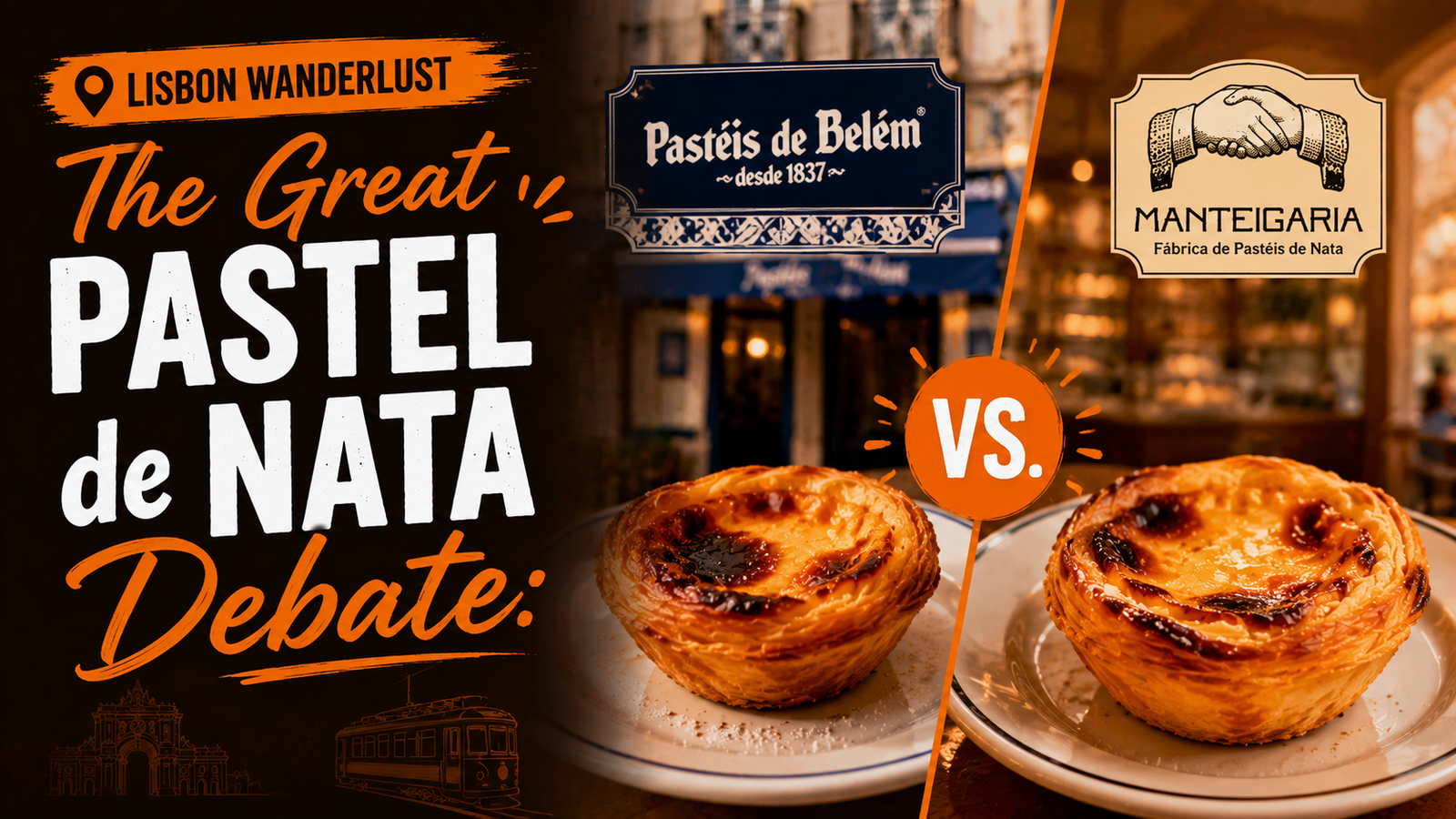
The Great Pastel de Nata Debate: Pastéis de Belém vs. Manteigaria
The choice between Pastéis de Belém and Manteigaria defines the Lisbon culinary experience for most international visitors.
While both establishments produce the iconic Portuguese custard tart, they cater to different logistical needs and palate preferences.
The following table provides an immediate comparison for travelers deciding where to allocate their time and appetite.
Pastéis de Belém – The Historical Authority
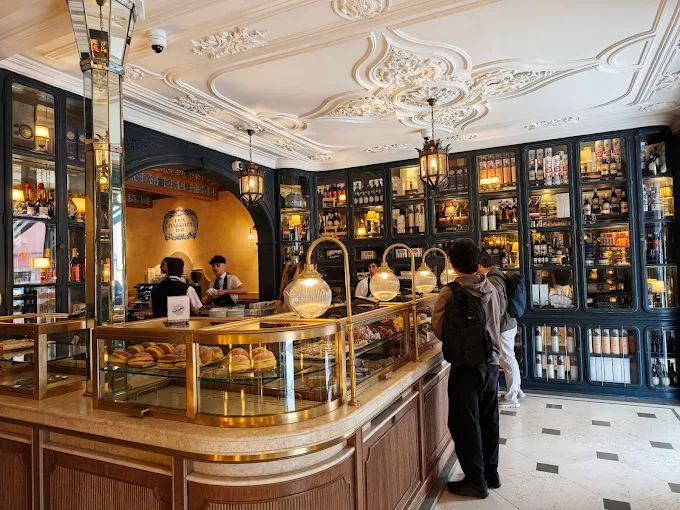
Pastéis de Belém is the only establishment legally allowed to use the name “Pastel de Belém.”
All other versions produced in Lisbon or globally are technically referred to as “Pastéis de Nata.”
The recipe originated in the early 19th century at the Mosteiro dos Jerónimos, located nearby.
Monks used egg whites to starch their habits, leaving a surplus of yolks for confectionery purposes.
Following the Liberal Revolution of 1820, the monastery began selling the tarts to a local sugar refinery.
The refinery opened the current bakery in 1837, using the exact “Secret Recipe” preserved today.
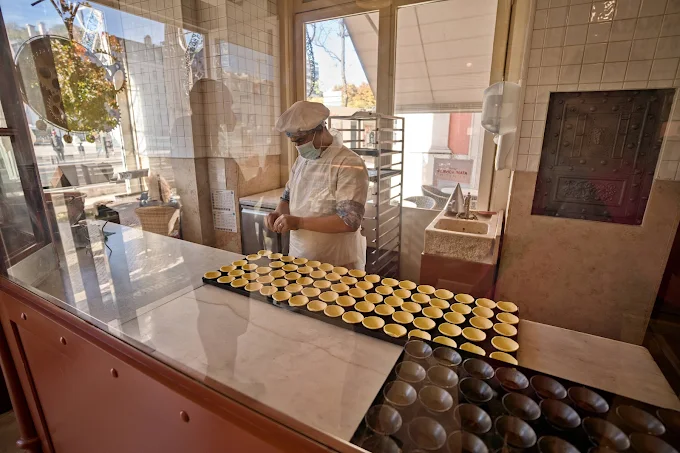
This recipe is guarded within the “Oficina do Segredo” (The Secret Workshop) by a handful of master bakers.
The technical distinction of the Belém tart lies in its specific puff pastry shell.
The dough is notably saltier than modern versions, providing a sharp contrast to the sweet custard.
The texture is characterized by a “shattering” crispness that stays firm even when the tart cools.
The custard center is slightly firmer and less sweet than the versions found in the city center.
It is traditional to sprinkle the warm tart with both cinnamon and powdered sugar before consumption.
Manteigaria – The Modern Gold Standard
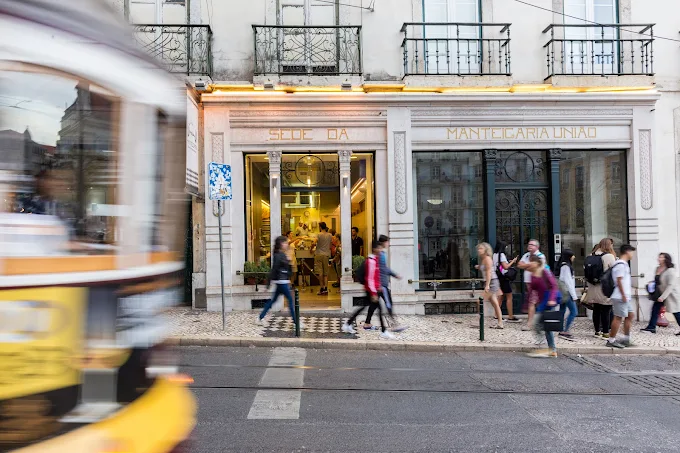
Manteigaria opened its doors in 2014, revitalizing the market with a focus on high-quality ingredients.
The name translates to “Butter Shop,” which reflects its core technical departure from traditional lard-based recipes.
By using high-grade butter in the lamination process, Manteigaria achieves a lighter, more aromatic pastry.
The flagship location on Rua do Loreto occupies a former butter warehouse built in 1900.
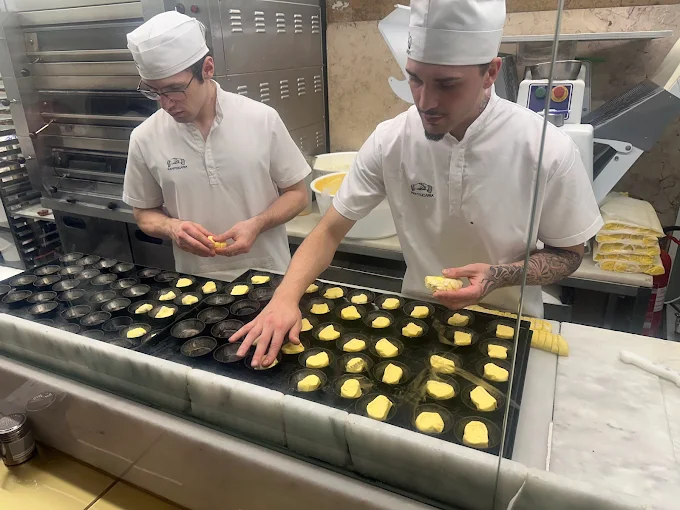
Unlike the sprawling halls of Belém, Manteigaria utilizes an open-kitchen concept behind glass partitions.
Visitors can observe the manual process of folding the dough and filling the shells with custard.
A distinctive feature of Manteigaria is the bell located above the entrance of their shops.
The staff rings this bell every time a fresh batch of tarts is pulled from the high-heat ovens.
This system ensures that customers almost always receive a tart that is still warm to the touch.
The custard at Manteigaria is known for a creamier, slightly more liquid consistency than the Belém version.
It features a more pronounced vanilla and lemon zest profile that appeals to modern palates.
The crust is thinner and focuses on a delicate, multi-layered flake rather than a heavy crunch.
Technical Sensory Comparison
Comparing these two icons requires looking at the “Alveolar” structure of the pastry.
Pastéis de Belém utilizes a traditional folding technique that results in thicker, more robust layers.
This allows the tart to hold its structural integrity for several hours after being baked.
Manteigaria’s pastry is engineered for immediate consumption, prioritizing a melt-in-the-mouth experience.
The Maillard reaction—the browning of the sugars—is more aggressive at Manteigaria.
This results in the signature dark, caramelized spots on the surface of the custard.
Pastéis de Belém maintains a more uniform, golden-brown appearance across the top.
In terms of temperature, Belém serves tarts at a consistent, warm-but-stable 40°C to 50°C.
Manteigaria often serves them at higher temperatures directly from the baking tray.
The salt content in the Belém crust acts as a palate cleanser, making it easier to eat multiple tarts.
Manteigaria’s richness comes from the fat content in the butter, which provides a longer-lasting aftertaste.
Both shops provide individual packets of cinnamon and sugar for takeaway orders.
Logistical Navigation and Locations
Reaching Pastéis de Belém requires a journey to the western district of Lisbon.
The most efficient transport is the 15E Tram or the 728 Bus from Praça do Comércio.
Alternatively, the train from Cais do Sodré to the Belém station takes approximately 7 minutes.
The shop features two distinct queues: one for takeaway and one for the internal dining rooms.
The takeaway queue is usually shorter but moves slower due to large bulk orders.
The internal seating area accommodates over 400 people across several historic blue-tiled rooms.
Manteigaria offers multiple locations, making it much more accessible for those staying in the center.
The Chiado location (Rua do Loreto 2) is ideal for those exploring Bairro Alto.
The Rossio location is situated near the main train station, perfect for a quick snack before a Sintra day trip.
The Time Out Market (Mercado da Ribeira) stall allows for a dessert following a meal at the food hall.
Pricing at both establishments is nearly identical, ranging from €1.20 to €1.35 per tart.
Discounts are typically offered when purchasing a “six-pack” (caixa de seis) in a traditional cardboard tube.
Expert Strategy – When to Visit
Peak hours for Pastéis de Belém occur between 11:00 AM and 4:00 PM, aligning with tour bus arrivals.
To avoid crowds, arrive at 8:00 AM when the doors open, or after 7:00 PM in the evening.
The seated area often looks full at the entrance, but many rooms are tucked deep in the back.
Walk past the first three rooms to find available tables in the larger, modern sections at the rear.
Manteigaria locations experience consistent flow but rarely have wait times exceeding 10 minutes.
The Chiado branch stays open until midnight, making it a popular late-night stop.
At the Time Out Market location, visit before 12:00 PM to avoid the lunch rush congestion.
For the freshest experience, wait for the bell to ring before joining the queue.
Credit cards are accepted at all Manteigaria branches and the Belém shop.
However, having small change (coins) is recommended for faster service at the takeaway counters.
Both shops are open seven days a week, including most public holidays.
Be aware that Belém can become exceptionally crowded on Sundays when the nearby museums are free for locals.
Beyond the Big Two – Information Gain
While the debate centers on the “Big Two,” other bakeries offer unique technical profiles.
Pastelaria Santo António, located near the Castelo de São Jorge, won the “Best Pastel de Nata” award in 2019.
Their version features a very light custard with a distinct hint of lemon peel.
Fábrica da Nata offers a more commercialized but high-quality experience on Rua Augusta.
They provide a “meal deal” that includes a glass of Port wine with a tart for under €5.00.
Confeitaria Nacional, founded in 1829, offers a more traditional, dense pastry style in Praça da Figueira.
For travelers who prefer a vegan option, “A Carioca” in Chiado occasionally stocks plant-based versions.
However, the traditional recipe relies heavily on egg yolks and cannot be truly replicated without them.
The “Best” tart is subjective and depends on your preference for salt vs. butter.
Serious enthusiasts should conduct a “blind taste test” by purchasing one from each on the same day.
Ensure tarts are kept level during transport to prevent the custard from shifting or leaking.
Avoid keeping tarts in plastic bags, as the steam will soften the crisp crust within minutes.
Storage and Reheating Guidelines
A Pastel de Nata is best consumed within 6 hours of leaving the oven.
If transport is necessary, use the provided cardboard boxes which allow the pastry to breathe.
Do not refrigerate the tarts if you plan to eat them the next day, as this ruins the crust texture.
Instead, keep them in a cool, dry place at room temperature.
To reheat, use a conventional oven or an air fryer at 180°C for approximately 3 to 5 minutes.
This restores the “snap” of the puff pastry without overcooking the custard.
Never use a microwave, as it makes the dough chewy and the custard dangerously hot.
If the custard has “deflated,” it is a sign the tart is no longer fresh.
Fresh tarts should have a slight dome or a flat, glossy surface.
When flying home, these tarts are permitted in carry-on luggage as they are considered solid food.
Place the box at the top of your bag to prevent the delicate crust from being crushed.
Enjoying a tart at the airport is possible, as there is a Manteigaria outlet in the departures area.
The Science of the Crust – Lard vs. Butter
The technical divergence in the crust is the most significant factor in the “Great Debate.”
Pastéis de Belém follows the medieval conventual tradition of using animal fats for lamination.
Lard provides a higher melting point, which results in a distinctively rigid and “crackling” texture.
This structural integrity is why Belém tarts do not become soggy when topped with heavy syrup or sugar.
Manteigaria utilizes high-fat-content European butter, which has a lower melting point than lard.
This creates a “short” pastry that shatters into thin, translucent flakes upon the first bite.
The butter-based dough offers a rich, nutty aroma that complements the sweetness of the custard.
Food scientists note that lard-based pastries tend to have a cleaner finish on the palate.
Butter-based pastries leave a thin coating of fat that carries the flavor of the vanilla longer.
Travelers who prefer a savory-sweet balance typically gravitate toward the Belém style.
Those seeking a decadent, dessert-forward experience usually favor Manteigaria.
Both methods require high-temperature ovens reaching up to 400°C for rapid expansion of the layers.
Custard Consistency – The Viscosity Factor
The “filling” or creme is a mixture of water, sugar, flour, milk, and high quantities of egg yolks.
Pastéis de Belém produces a custard with a denser, gelatinous set that holds its shape when cut.
This is achieved through a slightly higher flour-to-milk ratio during the thickening phase.
Manteigaria aims for a “lava-like” center that is slightly runny when served warm.
Their recipe utilizes a higher proportion of cream and egg yolks, resulting in a silkier mouthfeel.
The sweetness levels also differ significantly between the two competitors.
Belém tarts have a lower sugar content in the custard to account for the traditional addition of toppings.
Manteigaria tarts are designed to be eaten plain, with a sugar profile that is already peaked.
The browning on top, known as “caramelization,” provides a slight bitterness to balance the sugar.
In Belém, these spots are often lighter and more dispersed across the surface area.
At Manteigaria, the spots are often concentrated in large, dark “islands” of caramelized lactose.
The choice of milk—often a blend of whole milk—affects the richness of the final product.
Cultural Etiquette – How to Eat Like a Local
In Lisbon, the Pastel de Nata is rarely eaten as a dessert after a large dinner.
It is primarily a breakfast item or a mid-afternoon snack known as a lanche.
Locals usually pair the tart with a bica—a strong, short espresso shot.
The bitterness of the coffee cuts through the richness of the egg custard and fat.
When standing at the counter in Manteigaria, it is customary to eat the tart in two or three bites.
One should never use a knife and fork, as this destroys the delicate lamination of the crust.
At Pastéis de Belém, the experience is more formal, but the “hands-only” rule still applies.
The cinnamon shaker is not just for decoration; it is an essential part of the flavor profile.
Apply the cinnamon first, then a light dusting of powdered sugar to provide a textural contrast.
If the tart is cold, the sugar will not adhere as well to the surface.
In many local cafes, asking for a “Pastel de Nata” is the standard terminology.
Only in the Belém district should one specifically ask for a “Pastel de Belém.”
Production Volume and Global Impact
Pastéis de Belém produces approximately 20,000 to 30,000 tarts per day.
During peak summer months, this number can climb even higher to meet tourist demand.
Despite this volume, every tart is still made within the original facility in Belém.
Manteigaria has scaled differently by opening multiple specialized boutiques across the city.
This “micro-factory” model allows them to maintain quality control in high-traffic urban areas.
Each Manteigaria location functions as its own bakery, ensuring no tarts are transported cold.
This competition has elevated the global standard for Portuguese confectionery.
It has forced smaller pastelarias to improve their recipes to remain competitive.
The “Pastel de Nata” is now a global export, with shops appearing in London, New York, and Tokyo.
However, the specific humidity and water pH of Lisbon are said to affect the dough’s rise.
Authentic tarts in Lisbon often have a superior “crunch” compared to international versions.
The debate between the two giants serves as a primary driver for Lisbon’s culinary tourism.
Neighborhood Logistics – Belém vs. Chiado
Visiting Belém requires a dedicated half-day itinerary due to its distance from the city center.
Combine a visit to the bakery with the Jerónimos Monastery and the Belém Tower.
The bakery is located precisely at 38.6975° N, 9.2032° W for GPS navigation.
The 15E tram stop “Mosteiro Jerónimos” is less than 50 meters from the bakery entrance.
For Manteigaria in Chiado, the shop is a 2-minute walk from the Baixa-Chiado Metro station.
This location is ideal for those shopping on Rua Garrett or visiting the Bertrand Bookstore.
The Manteigaria in Rossio is located at Rua da Vitória 195, near the Santa Justa Lift.
This branch is often the least crowded of the central locations during morning hours.
The Time Out Market branch is the best choice for those traveling in large groups.
It allows different people to choose different foods while sharing a box of tarts.
Public restrooms are available inside the Belém bakery for paying customers.
Manteigaria locations are generally “grab-and-go” and do not offer restroom facilities.
Pricing and Value Analysis
As of 2024, a single tart at Pastéis de Belém costs approximately €1.30.
A sleeve of six tarts costs €7.80, with no bulk discount usually applied.
At Manteigaria, prices remain competitive at €1.25 to €1.30 per unit.
Prices at the Time Out Market may be slightly higher due to market commissions.
While these prices are higher than a standard neighborhood cafe (€0.90), the quality justifies the cost.
The use of real butter and fresh eggs instead of industrial premixes is the primary cost driver.
For the best value, avoid purchasing tarts at the airport or major train stations.
These are often marked up by 20% to 30% and may not be as fresh as the flagship shops.
Payment via contactless card is the fastest method at both establishments.
Always ask for a receipt (fatura) if you require one for travel expense tracking.
The packaging at both shops is designed to be sturdy enough for overhead bin storage.
Ensure the box is kept horizontal to prevent the custard from sticking to the lid.
Seasonal Considerations for Travelers
In the winter months (November to February), the warm tarts are a popular comfort food.
Wait times at Belém drop significantly during this period, often to under 10 minutes.
During the summer (June to August), the heat can make the rich custard feel heavy.
Plan visits for early morning to enjoy the tarts before the midday temperature peaks.
In June, during the Santos Populares festivals, the city is exceptionally crowded.
Manteigaria locations in Chiado will be very busy during the evening festivities.
Belém remains a more stable environment during the city-center festivals.
Rainy days often drive tourists into the large seating areas of Pastéis de Belém.
This can result in long waits for a table, even if the takeaway line is empty.
Manteigaria’s lack of seating makes it a less ideal stop during heavy rain.
Always check the official websites for holiday closures, though both generally remain open.
Lisbon’s humidity can soften the pastry, so eat them quickly on damp days.
Final Verdict – Which Should You Choose?
The decision ultimately depends on the traveler’s specific itinerary and texture preference.
If you value historical significance and a crunchy, salty crust, Pastéis de Belém is mandatory.
It offers a sense of place and tradition that cannot be replicated elsewhere.
If you prefer a buttery, flaky pastry and convenient central locations, choose Manteigaria.
Their consistent quality and “fresh batch” bell make it the most reliable choice for a quick snack.
Most culinary experts suggest trying both to understand the full spectrum of the Pastel de Nata.
Start with Belém in the morning to experience the origins of the recipe.
End your day with a warm tart from Manteigaria in Chiado for a modern comparison.
Both establishments represent the pinnacle of Portuguese baking and craftsmanship.
Regardless of the winner, the high turnover at both ensures a fresh product every time.
Lisbon Wanderlust recommends visiting Belém on a weekday to minimize wait times.
This concludes the definitive guide to Lisbon’s most famous culinary debate.
Final Logistics and “Know-Before-You-Go” Summary
To ensure a seamless visit to either establishment, travelers should keep the following technical details in mind for their itinerary planning.
Pastéis de Belém Contact and Location Details:
- Address: Rua de Belém 84-92, 1300-085 Lisboa.
- Official Website: pasteisdebelem.pt
- Contact: +351 21 363 74 23.
- Capacity: 400+ seats across 5 distinct rooms.
Manteigaria Key Location Details:
- Chiado: Rua do Loreto 2, 1200-108 Lisboa (Open until 12:00 AM).
- Rossio: Rua da Vitória 195, 1100-619 Lisboa.
- Time Out Market: Avenida 24 de Julho, 1200-479 Lisboa.
- Belém Branch: Rua de Belém 31 (Directly competing with the original).
Comparison Final Thoughts
The debate between Pastéis de Belém and Manteigaria is a testament to Lisbon’s dedication to its culinary heritage.
One offers a journey into the 19th-century monastic traditions with a saltier, crunchier profile.
The other offers a 21st-century masterclass in buttery, flaky pastry and urban convenience.
Whichever establishment is chosen, the result is a world-class example of Portuguese confectionery.
By following the logistical tips in this guide, visitors can avoid the heaviest crowds and enjoy their tarts at the peak of freshness.
Lisbon Wanderlust provides this data to ensure every traveler makes an informed decision based on facts rather than marketing.
Enjoy the exploration of Lisbon’s most iconic flavors.